
What's Happening?
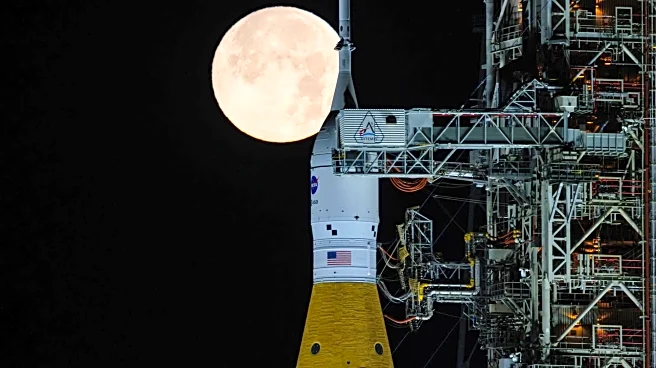
NASA has announced a delay in the launch of the Artemis II mission, which aims to send astronauts around the moon. Originally scheduled for February, the launch has been postponed to at least March 2026
due to a liquid hydrogen leak discovered during a practice launch rehearsal. The Artemis II mission is a critical step in NASA's Artemis program, which seeks to return humans to the moon for the first time since 1972. The mission will involve a crew of three American astronauts and one Canadian, who will travel beyond the moon's far side before returning to Earth. This mission follows the uncrewed Artemis I mission, which successfully tested NASA's Space Launch System (SLS) rocket in November 2022.
Why It's Important?
The delay of the Artemis II mission is significant as it impacts NASA's timeline for returning humans to the lunar surface, a key objective of the Artemis program. The mission is crucial for testing life support, navigation, and communication systems in deep space, which are essential for future lunar landings. The success of Artemis II will pave the way for Artemis III, planned for mid-2027, which aims to land astronauts on the moon. The delay also highlights the technical challenges and high costs associated with space exploration, as the SLS rocket program has already cost $23.8 billion since 2011. The postponement underscores the importance of thorough testing to ensure the safety and success of future missions.
What's Next?
NASA plans to conduct additional testing and a 'wet dress rehearsal' to address the issues identified during the practice launch. The agency is targeting March 2026 as the earliest possible launch window for Artemis II. The mission's success is critical for maintaining the schedule for Artemis III and the broader goals of the Artemis program, including the establishment of a lunar space station and preparation for future Mars missions. NASA will continue to monitor weather conditions and other factors that could affect the launch schedule, with potential launch windows identified in March and April.