
What's Happening?
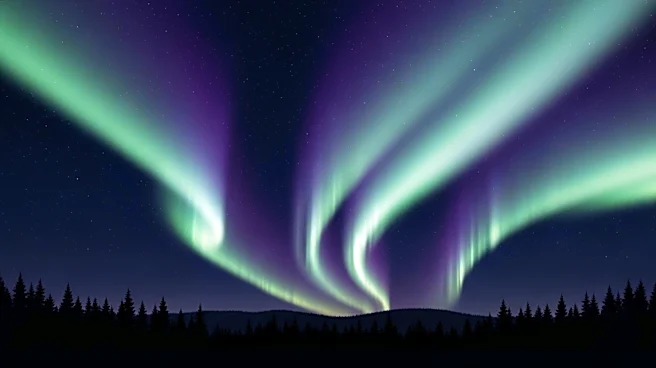
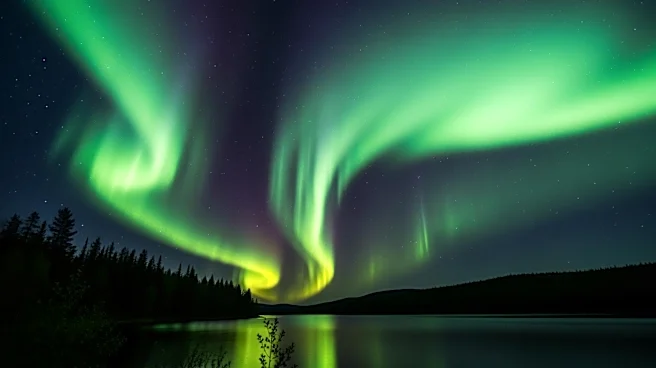
A significant geomagnetic storm is expected to create a rare opportunity for millions of Americans to witness the Northern Lights this week. The National Oceanic and Atmospheric Administration's Space
Weather Prediction Center has issued a G3, or 'strong,' geomagnetic storm watch for Thursday and Friday. This event is driven by multiple coronal mass ejections (CMEs) from the Sun, which have sent charged particles toward Earth. As these particles interact with Earth's magnetic field, they transfer energy into the upper atmosphere, potentially resulting in vivid auroral displays across much of the northern United States. The phenomenon occurs when solar particles collide with atmospheric gases, exciting oxygen and nitrogen molecules, which then emit light as they return to their normal energy state.
Why It's Important?
The potential visibility of the Northern Lights across the United States is a rare event, typically confined to regions near the Arctic Circle. This occurrence provides a unique opportunity for educational and scientific engagement, as well as a chance for millions to experience a natural spectacle. The event underscores the impact of solar activity on Earth's atmosphere and highlights the importance of space weather monitoring. For scientists, it offers a chance to study the interactions between solar particles and Earth's magnetic field, which can have broader implications for understanding space weather's effects on satellite operations and power grids.
What's Next?
As the geomagnetic storm progresses, space weather experts will continue to monitor its development and provide updates. The public is encouraged to stay informed through resources like NOAA's Space Weather Prediction Center. If the storm's intensity increases, it could lead to more widespread auroral displays, potentially visible further south than initially anticipated. This could prompt increased interest and participation in citizen science projects related to aurora tracking and space weather observation.
Beyond the Headlines
The event highlights the interconnectedness of solar activity and terrestrial phenomena, emphasizing the need for continued investment in space weather research and monitoring infrastructure. Understanding these interactions is crucial for mitigating potential disruptions to technology and communication systems caused by geomagnetic storms. Additionally, the cultural and aesthetic appreciation of the Northern Lights can foster a greater public interest in astronomy and environmental science.