





What's Happening?
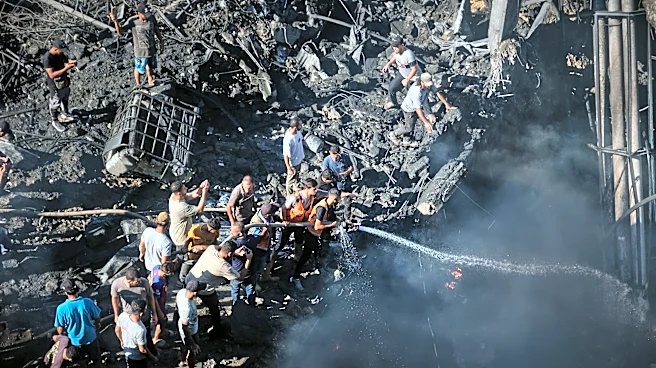
Reuters and The Associated Press (AP) have jointly called for a full explanation from Israeli officials regarding the deaths of five journalists, including their own staff, during Israeli strikes in Gaza one year ago. The incident occurred at Nasser Hospital,
where Reuters cameraman Hussam al-Masri and AP visual journalist Mariam Dagga were among those killed. Despite the passage of a year, no one has been held accountable for these deaths. Alessandra Galloni, editor-in-chief of Reuters, and Julie Pace, executive editor of AP, emphasized the critical need for transparency and urged Israel to implement measures to safeguard journalists covering the ongoing conflict. The Israeli military had stated that the target was a suspected Hamas camera on the hospital roof. However, the AP has repeatedly requested details about the investigation and a timeline for its completion, but no information has been provided. Rights groups frequently criticize Israel for rarely holding its troops accountable for the deaths of Palestinians, citing lengthy investigations that seldom result in prosecution.
Why It's Important?
This joint demand from two major international news organizations underscores significant concerns about press freedom and the safety of journalists operating in conflict zones. The lack of accountability for the deaths of journalists can have a chilling effect on reporting, potentially hindering the public's access to crucial information from areas of conflict. For U.S. media, the incident highlights the risks faced by their personnel abroad and the challenges in securing justice when journalists are killed in the line of duty. The call for protection and accountability is vital for maintaining the integrity of independent journalism and ensuring that international humanitarian law, which protects civilians and non-combatants, is upheld. The ongoing failure to provide answers also contributes to a broader narrative of impunity, which can erode trust in international legal frameworks and the ability of global bodies to protect human rights.
What's Next?
The immediate next step will likely involve continued pressure from Reuters, AP, and other international press freedom organizations on Israeli authorities to provide the requested information and accelerate any ongoing investigations. It remains to be seen whether this renewed public call will prompt a more substantive response from Israel, including details about the investigation's progress or a commitment to accountability. International bodies and human rights advocates may also amplify these calls, potentially leading to increased scrutiny of Israel's conduct regarding journalist safety in conflict areas. The situation could also influence future reporting strategies for news organizations in high-risk regions, potentially leading to enhanced safety protocols or more cautious deployment of personnel if assurances of protection are not met.
Beyond the Headlines
The incident at Nasser Hospital and the subsequent lack of accountability touch upon deeper issues concerning the rules of engagement in modern warfare and the specific protections afforded to journalists under international law. The targeting of a hospital, even with the claim of a suspected Hamas camera, raises questions about proportionality and the distinction between civilian and military targets. The broader implication is the erosion of the principle that journalists are non-combatants and should be protected, a cornerstone of press freedom. This case could set a precedent, or reinforce existing negative ones, regarding the impunity with which journalists can be killed in conflict zones, making it increasingly dangerous for media to report independently. It also highlights the persistent challenge of holding state actors accountable for actions taken during military operations, particularly when those actions result in civilian casualties, including those of the press.