
What's Happening?
Mahamat Idriss Déby was confirmed president-elect of Chad on May 16, 2024, following a disputed election on May 6. His election formalizes a military transition that began when he took power in April 2021
after his father's death. Chad's economy remains heavily dependent on Doba crude oil exports, which accounted for 14.3% of GDP, 51.8% of government revenues, and 65.3% of exports in 2024, according to World Bank figures. The country faces significant humanitarian and economic pressures, including hosting over one million Sudanese refugees, chronic hunger, and a projected public debt stock near 28.7% of GDP for 2026. The political transition concluded with Déby's election, formally ending the post-2021 process. In October 2025, Chad's Parliament approved constitutional amendments extending the presidential term from five to seven years, a move boycotted by some opposition parties.
Why It's Important?
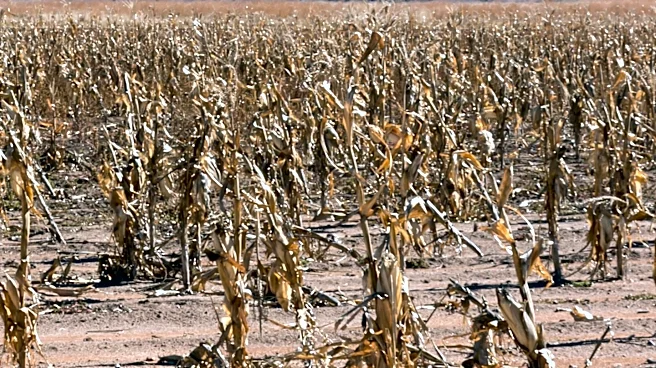
Chad's reliance on Doba crude oil exports through Cameroon creates significant economic vulnerability, as any disruption to this single corridor can severely impact the nation's fiscal stability. The formalization of Déby's presidency, while ending a military transition, has not brought about economic transformation, leaving the country susceptible to global oil price fluctuations and domestic weather failures affecting its rain-fed agriculture. The substantial influx of over one million Sudanese refugees places immense fiscal and food-security pressure on an already strained state, diverting resources that could otherwise address chronic hunger and development needs. This situation creates a complex environment for investors, who must weigh the political stability offered by Déby's extended term against the inherent concentration risk of an oil-dependent economy and the long-term social spending required to address humanitarian crises. The bifurcated investment landscape, with Chinese capital focusing on infrastructure and Western investment on aid, further complicates Chad's economic trajectory.
What's Next?
Chad's economic stability will continue to hinge on the uninterrupted flow of Doba crude through the Cameroon export chain. The projected narrowing of the fiscal deficit to 0.4% of GDP in 2026 is contingent on favorable oil prices and non-oil growth, both of which are vulnerable to climate and security shocks. International humanitarian funding will remain crucial to support the over one million Sudanese refugees, but it will not fully offset the strain on public services and local revenues. Bilateral and multilateral creditors will closely monitor the impact of the post-election constitutional changes and the extended presidential term on governance risk. Investors will need to assess whether oil revenues can outpace the combined challenges of hunger, displacement, and debt service. The slow projected decline in poverty, from 40.7% in 2025 to 39.5% by 2028, indicates that food access will remain a critical developmental and political challenge, potentially impacting social stability.
Beyond the Headlines
The formalization of Mahamat Idriss Déby's presidency through a disputed election highlights the ongoing challenges of democratic transitions in regions prone to political instability. While the election concludes a military transition, it underscores the difficulty of achieving genuine economic transformation without diversifying away from a single commodity. The extension of the presidential term, despite opposition boycotts, raises questions about the long-term democratic health and governance in Chad. The immense burden of hosting over a million refugees, coupled with chronic food insecurity, points to a deeper humanitarian crisis that transcends economic indicators. This situation creates a moral imperative for international actors to provide sustained support, not just for immediate relief but also for long-term development and resilience-building. The interplay between political stability, economic vulnerability, and humanitarian crises in Chad serves as a microcosm of broader challenges faced by many developing nations, where external factors like global oil prices and regional conflicts significantly impact domestic well-being and governance.