



What's Happening?
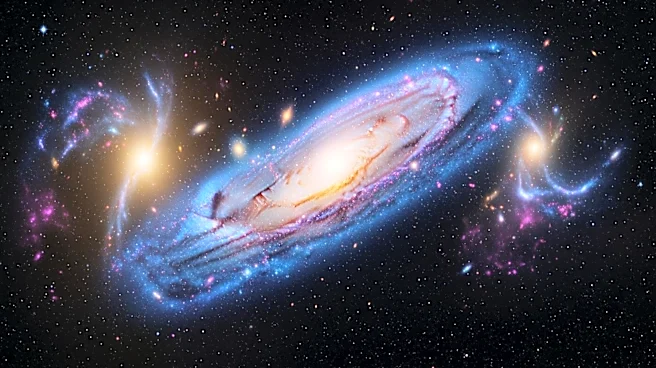
The James Webb Space Telescope has confirmed the existence of MoM-z14, the most distant spectroscopically confirmed galaxy, whose light left it about 280 million years after the Big Bang. This discovery is part of a growing population of early galaxies
that appear brighter and more numerous than previously predicted by models. These findings are prompting a revision of how quickly the first galaxies turned gas into stars. The telescope's observations have revealed an excess of ultraviolet-bright galaxies at very high redshift, beyond redshift 10, which was first noted in Webb's initial data in 2022. Two significant galaxies, JADES-GS-z14-0 and MoM-z14, have been identified at redshifts of 14.32 and 14.44, respectively, indicating they formed less than 300 million years after the Big Bang.
Why It's Important?
The discoveries made by the James Webb Space Telescope are significant as they challenge existing astrophysical models of early galaxy formation. The unexpected brightness and abundance of these early galaxies suggest that star formation may have been more efficient in the early universe than previously thought. This has implications for our understanding of the universe's evolution and the processes that governed the formation of the first galaxies. The findings do not challenge the Big Bang theory itself but rather suggest revisions to the astrophysical models that describe how galaxies formed and evolved in the early universe. This could lead to new insights into the conditions of the early universe and the factors that influenced galaxy formation.
What's Next?
Future research will focus on larger spectroscopic samples to better understand the prevalence of these bright early galaxies. Scientists aim to measure how much faster these galaxies formed and to distinguish the light from young stars from that of black holes growing alongside them. Additionally, further chemical analysis, such as the detection of elements like oxygen, will help refine models of chemical enrichment in the early universe. These efforts will contribute to a more comprehensive understanding of the processes that shaped the early universe and the formation of galaxies.