



What's Happening?
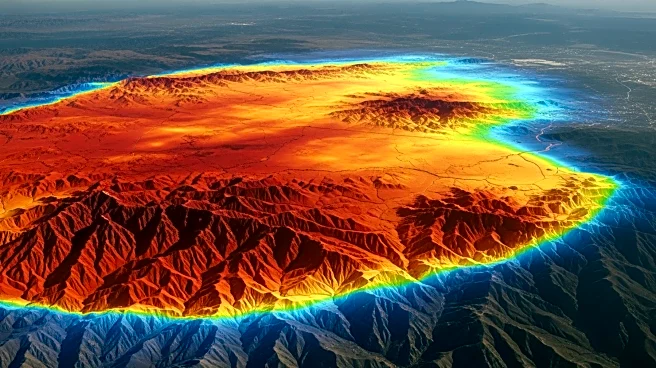
A recent study has identified a massive geological feature known as the Northern Appalachian Anomaly (NAA), a giant mass of hot rock, moving towards New York City. This anomaly, believed to have played a role in the historical separation of Canada and
Greenland 80 million years ago, is now under scrutiny for its potential impact on geological formations. The study, published in the journal Geology, suggests that this thermal upwelling is part of a larger, slow-moving process deep underground. Researchers used geodynamic simulations and seismic tomography data to trace the origins of the NAA back to the Labrador Sea. The anomaly is currently located 200 kilometers beneath the Appalachian Mountains and is migrating at a rate of 20 kilometers per million years.
Why It's Important?
The discovery of the Northern Appalachian Anomaly offers new insights into the geological history and ongoing processes beneath the Earth's surface. This research challenges long-held beliefs about continental drift and the formation of mountain ranges like the Appalachians. Understanding these deep-earth processes is crucial for geologists as it may explain the persistence of ancient mountain ranges and provide clues about future geological changes. The study's findings could have implications for predicting seismic activity and understanding the Earth's tectonic behavior, which is vital for infrastructure planning and disaster preparedness in affected regions.
What's Next?
While the NAA is not expected to reach New York City for another 15 trillion years, the study opens up new avenues for research into the Earth's mantle dynamics. Scientists may continue to explore the 'mantle wave' theory, which suggests that molten material beneath the Earth's surface behaves like a lava lamp, influencing continental buoyancy and mountain formation. Further research could focus on the potential impacts of such anomalies on seismic activity and the stability of geological structures. This ongoing research may also lead to a reevaluation of geological models and theories related to continental drift and tectonic movements.