



What's Happening?
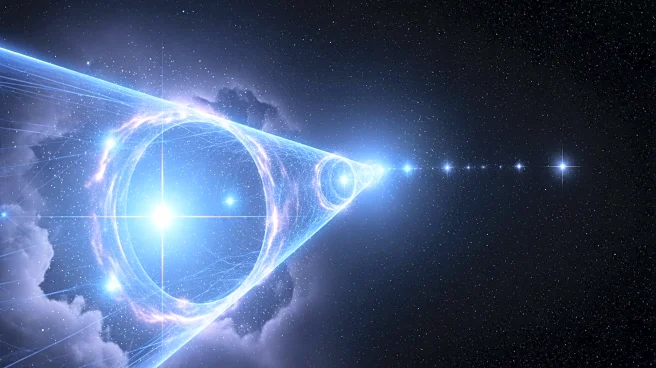
Astronomers from the Max Planck Institute have identified a cosmic 'tunnel' that appears to connect our solar system to distant stars. This discovery was made using data from the eRosita instrument, which is part of the Spectrum-Roentgen-Gamma mission.
The study, published in the journal Astronomy & Astrophysics, reveals a channel of hot, low-density plasma extending from our solar system towards the Centaurus constellation. This channel is part of the Local Hot Bubble, a region formed by ancient supernova explosions that created a low-density, high-temperature environment. The findings suggest that this 'tunnel' might be part of a larger network of interstellar channels connecting star-forming regions and pockets of heated gas.
Why It's Important?
The discovery of this interstellar 'tunnel' has significant implications for our understanding of the cosmos. It challenges previous assumptions about the structure of space around our solar system and suggests a more complex network of interstellar matter than previously thought. This could impact theories on how cosmic rays travel and how interstellar dust and gas are distributed. The presence of such channels may influence the dynamics of stellar winds and the flow of cosmic rays, potentially affecting the conditions within our solar system. This discovery also highlights the importance of advanced astronomical instruments like eRosita in uncovering hidden structures in space.
What's Next?
Further exploration of these cosmic channels will require more sensitive instruments and deeper surveys. Future X-ray missions and refined models of hot gas distribution are expected to enhance our understanding of these structures. Astronomers aim to map more of this cosmic network and determine how these channels affect local cosmic phenomena. Continued research may reveal additional pathways and provide insights into the evolution of interstellar matter. As technology advances, these discoveries could redefine our understanding of the universe and our place within it.
Beyond the Headlines
The identification of these interstellar channels underscores the complexity of space and the dynamic processes that shape it. The findings suggest that space is not merely empty but filled with intricate structures formed by ancient cosmic events. This challenges the traditional view of space as a void and highlights the role of supernovae in sculpting the interstellar medium. The study also raises questions about the potential for similar structures elsewhere in the galaxy and their impact on galactic evolution. Understanding these channels could provide new insights into the history of our cosmic neighborhood and the forces that have shaped it over millions of years.