
What's Happening?
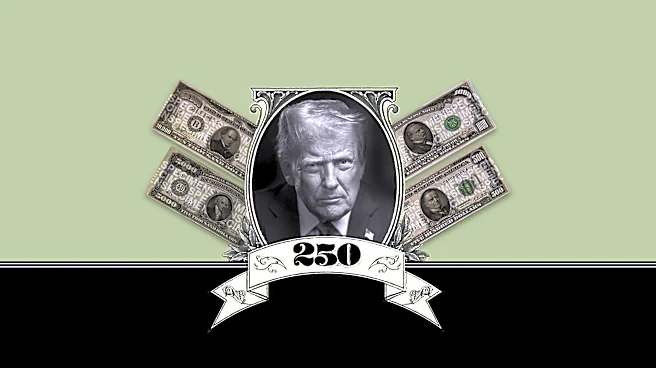
The Treasury Department is exploring the possibility of issuing a new $250 bill featuring President Trump, a proposal that has sparked controversy due to legal and logistical challenges. Federal law, established
in 1866, prohibits the depiction of living individuals on U.S. currency, necessitating a congressional amendment for the bill to proceed. The Treasury is conducting preliminary assessments, but the creation of a new denomination involves extensive anti-counterfeiting measures and coordination with multiple agencies, a process that could take years. The proposal, intended to commemorate the 250th anniversary of the United States, has faced criticism for potentially politicizing U.S. currency.
Why It's Important?
The proposal to feature President Trump on a $250 bill raises significant legal and political questions. If pursued, it would require Congress to amend longstanding laws, setting a precedent for future currency designs. The initiative could also influence public perception of U.S. currency as a non-partisan symbol. Additionally, the logistical challenges and costs associated with introducing a new denomination could impact federal resources and priorities. The proposal's timing, amid economic concerns, adds to the debate over its necessity and potential implications for U.S. fiscal policy.
What's Next?
Should Congress decide to amend the law, the proposal would need to pass through several legislative stages, including approval by the House Financial Services Committee, the House, and the Senate, before being signed into law. The Treasury Department would then undertake the complex process of designing and testing the new bill, which could take several years. The proposal's progress will likely be closely monitored by political leaders, financial institutions, and the public, with potential reactions influencing its viability.