
What's Happening?
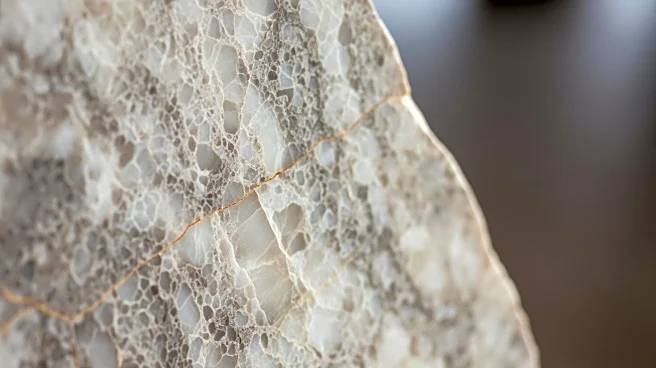
A recent study has conducted uniaxial cyclic compression tests on marble specimens to understand the failure process using acoustic emission (AE) characteristics. The research integrates AE time-series analysis, three-dimensional event localization, b-value
evolution, and fractal dimension characterization. The study reveals that AE parameters, including event frequency, spatial distribution, b-value, and fractal dimension, effectively characterize the initiation, propagation, and coalescence of cracks during marble failure. The findings provide insights into the internal damage and fracture development in rocks under stress.
Why It's Important?
This study is significant for industries involved in construction and mining, where understanding the failure mechanisms of materials like marble is crucial. By using fractal analysis, the research offers a quantitative method to evaluate the structural complexity and predict failure in rock masses. This can lead to improved safety measures and more efficient resource extraction processes. The ability to predict material failure can also enhance the design and durability of structures, reducing the risk of catastrophic failures and associated economic losses.
What's Next?
Future research may focus on applying these findings to other types of rocks and materials to generalize the predictive capabilities of fractal analysis. There is also potential for developing new technologies or software that can automate the analysis of AE data, making it more accessible for practical applications in the field. Collaboration between researchers and industry professionals will be essential to translate these scientific insights into real-world solutions.
Beyond the Headlines
The use of fractal analysis in understanding material failure highlights the intersection of mathematics and engineering. This approach not only provides a deeper understanding of material behavior but also challenges traditional methods of analysis. As industries continue to seek more efficient and reliable ways to assess material integrity, the integration of advanced mathematical models will likely become more prevalent, driving innovation in engineering and construction practices.