
What's Happening?
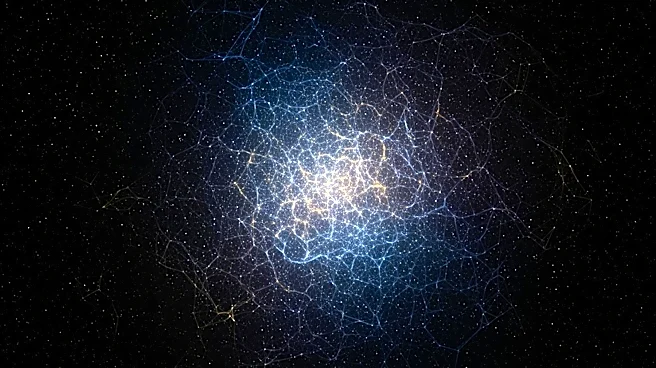
The Dark Energy Spectroscopic Instrument (DESI) has completed a five-year survey, creating the most detailed map of the universe to date. Conducted at the Kitt Peak National Observatory in Arizona, DESI mapped
over 47 million galaxies and quasars, surpassing initial expectations of 34 million. The survey aimed to measure the positions and distances of galaxies across billions of light years, providing a three-dimensional view of the cosmos. Researchers hope the data will help answer questions about dark energy and its potential changes over time. The completed map covers approximately 14,000 square degrees of the sky, with plans to expand further.
Why It's Important?
The DESI survey represents a significant advancement in cosmology, offering insights into the distribution of matter in the universe. By mapping millions of galaxies, scientists can study the effects of dark energy, which is believed to drive the universe's expansion. Understanding dark energy is crucial for refining the standard model of cosmology and addressing fundamental questions about the universe's fate. The survey's extensive dataset provides a valuable resource for researchers, enabling more accurate studies of cosmic history and structure. As the largest spectroscopic survey ever completed, DESI sets a new benchmark for astronomical research.
What's Next?
Following the completion of the main survey, researchers will process the data for broader scientific access. The DESI collaboration plans to continue observations for another two and a half years, potentially extending the project into the 2030s. Scientists will use the data to investigate dark energy's behavior and its implications for cosmology. The findings may challenge existing theories and lead to new models of the universe's expansion. As the analysis progresses, the scientific community anticipates groundbreaking discoveries that could reshape our understanding of the cosmos.