






What's Happening?
Scientists from the University of Washington, led by ecologists Natalie Mastick and Chelsea Wood, have utilized decades-old canned salmon to study the health of the Northeast Pacific's marine ecosystems. The research involved analyzing 178 cans of salmon,
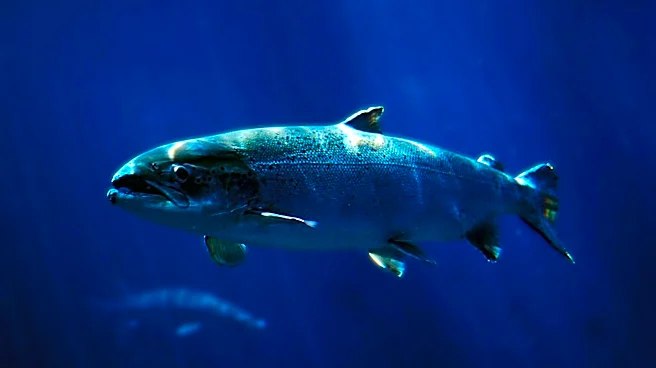
some dating back to the 1970s, which were originally stored by the Seattle-based Association of Seafood Producers for quality control. Inside these cans, researchers found marine worms from the Anisakidae family, which are harmless to humans once cooked. These parasites act as ecological indicators, as their life cycle involves various marine species, including krill, fish, and marine mammals. The presence and population dynamics of these worms can reflect the stability and health of the ecosystem. The study, published in the journal Ecology and Evolution, meticulously dissected salmon fillets from four Pacific salmon species caught between 1979 and 2021 in the Gulf of Alaska and Bristol Bay: Chum, Coho, Pink, and Sockeye salmon. The researchers counted the number of worms per gram of fish to identify trends over time.
Why It's Important?
This novel research method offers a unique and cost-effective way to retroactively assess the health of marine ecosystems over several decades. Traditional ecological studies often require extensive fieldwork and historical data, which can be limited. By using archived food products like canned salmon, scientists can access a 'miniature sample of Alaska’s ecological history' without needing to conduct new expeditions. The findings revealed an increase in parasites in chum and pink salmon over time, while numbers remained steady in coho and sockeye. According to Natalie Mastick, this increase suggests that the parasites have found all the necessary hosts for their reproduction, potentially indicating a stable or recovering ecosystem. This approach highlights the unexpected value of ordinary archives for scientific discovery and provides valuable insights into long-term ecological changes, which are crucial for conservation efforts and understanding the broader impacts of environmental shifts on marine life and fisheries.
What's Next?
While the study provided significant insights, the scientists noted that they could not always pinpoint the parasites down to the exact species. This leaves open questions regarding whether specific species of Anisakidae are expanding while others remain unchanged. Future research could focus on more precise identification of these parasite species to gain a more granular understanding of ecosystem dynamics. The success of this method also suggests that other archived food products or biological samples could be explored for similar ecological studies, potentially unlocking further historical data about various ecosystems. This approach could lead to the development of new, non-invasive methods for long-term environmental monitoring, influencing how scientists approach historical ecological research and resource management.
Beyond the Headlines
The study challenges the common perception that finding parasites in food is inherently a sign of an unhealthy environment. Instead, as Chelsea Wood explains, the presence of these marine worms can actually indicate a healthy ecosystem because their complex life cycle requires a robust food web. If higher hosts like whales or seals decline, the parasites' life cycle breaks, leading to a drop in their populations. This perspective underscores the intricate interconnectedness of species within an ecosystem and the often-overlooked role of parasites as bio-indicators. The research also highlights the ethical dimension of scientific inquiry, demonstrating how seemingly mundane items, like old canned goods, can be transformed into invaluable scientific resources, prompting a reevaluation of what constitutes a 'scientific sample' and encouraging innovative thinking in ecological research.