



What's Happening?
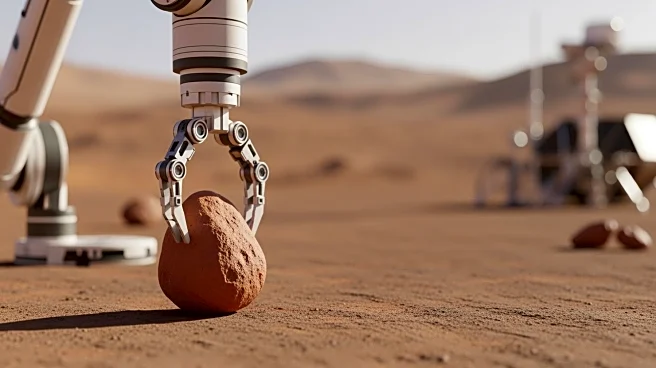
NASA is employing robotic missions to tackle various challenges associated with future human exploration of Mars. These robots are being used to gather critical data on Mars' environment, such as radiation levels and the presence of water, which are essential
for ensuring the safety and success of human missions. The robots are not merely placeholders but are considered partners that continue to work even after humans arrive. They help in understanding the risks posed by Mars' thin atmosphere and lack of a global magnetic field, which leaves the surface exposed to solar storms. NASA's Gina DiBraccio highlighted a decision support tool that uses data from Mars orbiters and rovers to provide real-time space weather conditions, aiding astronauts in taking necessary precautions during solar flares. Additionally, the MAVEN mission has provided a comprehensive catalogue of Martian space weather events, aiding in the planning of future missions.
Why It's Important?
The use of robots in Mars exploration is crucial for mitigating risks and enhancing the safety of future human missions. By understanding the environmental challenges on Mars, such as radiation exposure and dust, NASA can develop strategies to protect astronauts and ensure mission success. The data collected by these robotic missions informs the design of habitats and daily routines for future crews, potentially reducing the risks associated with long-term space travel. This approach also represents a shift in space exploration strategy, where robots and humans work in tandem rather than as alternatives, maximizing the efficiency and safety of missions.
What's Next?
NASA plans to continue using robotic missions to gather more detailed data on Mars' environment. Future missions may include deploying small drones equipped with magnetometers to map regions with local magnetic fields, which could offer limited radiation shielding. These efforts aim to identify optimal locations for building habitats and conducting activities on Mars. As robotic technology advances, it will play an increasingly vital role in preparing for human exploration, ensuring that astronauts have the information and tools needed to thrive on the Martian surface.
Beyond the Headlines
The integration of robotic missions into space exploration highlights a broader trend of using technology to solve complex problems in extreme environments. This approach not only enhances the safety and feasibility of human missions but also contributes to our understanding of planetary science. The data collected by these missions can inform future exploration efforts on other celestial bodies, paving the way for more ambitious space endeavors. Additionally, the collaboration between robots and humans in space exploration could have implications for other fields, such as autonomous systems and artificial intelligence, driving innovation and technological advancement.