
What's Happening?
A recent study led by Xuheng Ma from the University of Wisconsin suggests that there are fewer small galaxies in the early universe than previously predicted. Using data from the James Webb Space Telescope's
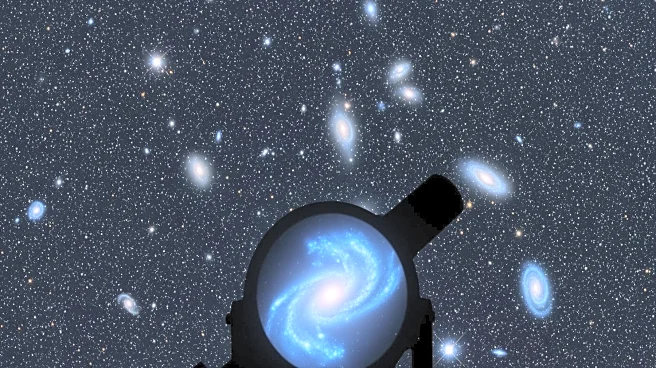
UNCOVER program, researchers examined the Abell 2744 galaxy cluster, which acts as a gravitational lens to reveal distant galaxies. The study found a trend called faint-end suppression, where the number of small, faint galaxies decreases below a certain brightness. This challenges the assumption that tiny galaxies were the primary drivers of the Epoch of Reionization, a period when the first stars and galaxies transformed the universe's gas into ionized plasma.
Why It's Important?
The findings have significant implications for our understanding of the universe's evolution. If small galaxies are not as numerous as thought, they may not have been the main contributors to the reionization of the universe. This could shift the focus to larger galaxies as the primary sources of ultraviolet radiation during this critical phase. The study also highlights the need to reassess models of galaxy formation and evolution, potentially altering the narrative of how the universe developed from the cosmic dark ages to its current state.
What's Next?
Further research is needed to confirm whether the observed trend is a local anomaly or a fundamental cosmic rule. Upcoming surveys and additional data from the James Webb Space Telescope will help determine the prevalence of this phenomenon across the sky. This could lead to a reevaluation of the role of small galaxies in the universe's history and provide new insights into the processes that shaped the cosmos.