




What's Happening?
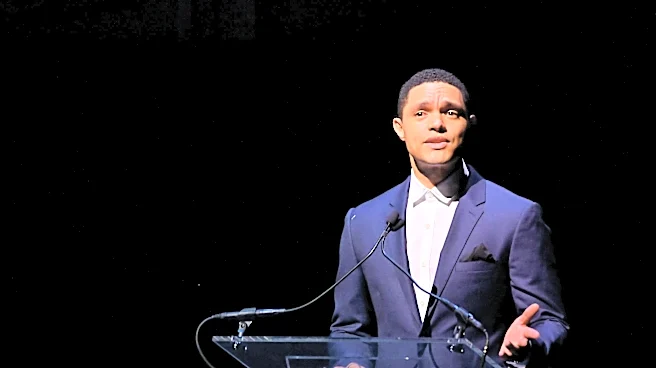
On October 19, Trevor Noah, the former host of The Daily Show and Microsoft’s Chief Questions Officer, launched 'Luminaries,' a science conversation series at Boston's Museum of Science. During a discussion moderated by Rana el Kaliouby, a pioneer of emotion
AI, Noah shared his insights on artificial intelligence, particularly its struggles with humor and its broader societal implications. He identified four key reasons why AI falls short in comedy: insufficient comedy data, AI models being static snapshots while societal humor evolves, the necessity of knowing one's audience for effective humor, and companies making AI models risk-averse. Noah also noted that AI often appears profound but only processes surface-level information, and that while technology has always created new jobs, the 'following distance' or gap between job displacement and creation is a critical concern.
Why It's Important?
Trevor Noah's perspective on AI's limitations in humor and its impact on jobs is significant because it comes from a prominent cultural commentator who bridges entertainment and technology. His insights challenge the often-optimistic narratives surrounding AI by highlighting its current deficiencies in understanding complex human nuances like comedy. This is crucial for managing public expectations about AI's capabilities and preventing over-reliance on it for tasks requiring genuine human understanding and creativity. Furthermore, his analogy of the 'following distance' in job displacement offers a critical framework for policymakers and businesses to consider the social and economic consequences of automation. It underscores the need for proactive strategies to support workers during transitions, rather than simply assuming new jobs will naturally emerge without significant societal disruption.
What's Next?
The ongoing dialogue about AI's capabilities and limitations, as exemplified by Noah's discussion, is expected to continue shaping public perception and policy. As AI technology advances, there will likely be increased scrutiny on its ethical implications, particularly in creative fields and the job market. Noah's role as Microsoft's Chief Questions Officer suggests a continued engagement with these topics, potentially influencing how technology companies approach AI development with a greater emphasis on human-centric design and societal impact. Future discussions will likely focus on how to foster community and human connection as a defense against potential dystopian AI futures, as Noah suggested, and how to ensure that technological progress benefits all segments of society, not just those in positions of privilege.
Beyond the Headlines
Noah's commentary extends beyond the immediate technical aspects of AI to touch upon deeper philosophical and sociological questions. His observation that 'white-collar workers are now experiencing what many blue-collar workers experienced for decades' due to automation highlights a critical shift in the impact of technological change across different socioeconomic strata. This insight could foster greater empathy and understanding across various labor sectors regarding the challenges of job displacement. Moreover, his emphasis on the importance of in-person community as a defense against a dystopian AI future underscores the enduring value of human connection and social capital in an increasingly digital world. This perspective encourages a re-evaluation of what truly constitutes progress and well-being in an AI-driven society.