




What's Happening?
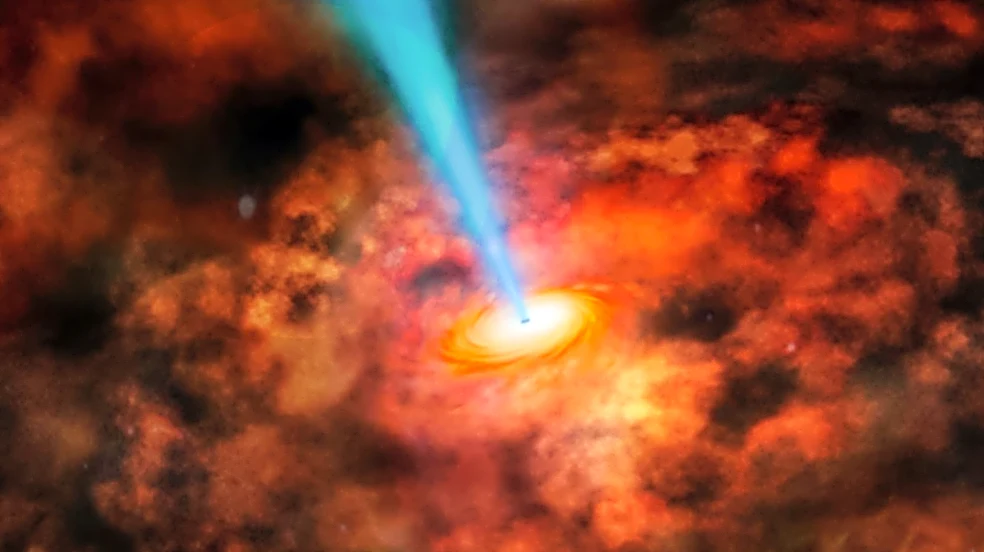
Astronomers have identified a massive black hole, designated TDE 2023mfm, located approximately 3,500 light-years from its galaxy's center. This discovery was made possible when the black hole tore apart a passing star in a tidal disruption event (TDE),
causing a bright flare detectable across multiple wavelengths. Typically, massive black holes are found at the centers of galaxies, making this off-nuclear location unusual. A research team led by Itai Sfaradi of the University of California utilized observations from various telescopes, including the Hubble Space Telescope and the Very Large Array, to study the event. The flare reached peak optical brightness within about 30 days and gradually faded over 100 days, maintaining a temperature near 20,000 Kelvin. The black hole's mass is estimated to be between one million and ten million solar masses. The delayed radio emission, appearing nearly three years after the event, and the persistent X-ray faintness, further distinguish TDE 2023mfm from other observed TDEs.
Why It's Important?
This discovery challenges existing understandings of black hole distribution and galactic evolution. The presence of a massive black hole so far from its galaxy's nucleus suggests alternative formation or migration mechanisms. One leading explanation involves an earlier galactic collision, where a smaller galaxy merged with a larger host, leaving its central black hole stranded. The identification of a compact concentration of stars near the disruption site supports this theory, potentially representing the surviving core of a smaller galaxy. Another possibility is that the black hole was ejected from a triple massive black hole system due to gravitational wave recoil or asymmetric gravitational-wave emission during a merger. These findings provide crucial insights into the dynamics of black holes and galaxies, particularly how black holes move through galaxies and the long-term consequences of galactic mergers. Understanding these 'wandering' black holes can help refine models of galaxy formation and evolution.
What's Next?
Continued monitoring of TDE 2023mfm is crucial for clarifying the origin of its delayed radio signal and understanding the environment surrounding this displaced black hole. Deeper observations may reveal more about the stellar structure in its vicinity. The research team anticipates that if radio emission is also detected from the off-nuclear TDE, it could confirm the presence of an off-nuclear massive black hole and provide a precise measurement between the two massive black holes within the galaxy. Future studies will aim to distinguish between the proposed scenarios for its off-center location, such as a minor galaxy merger or ejection from a triple black hole system. This ongoing research will contribute to a broader understanding of how massive black holes are distributed within galaxies and the processes that lead to their unusual placements.
Beyond the Headlines
The discovery of TDE 2023mfm highlights the limitations of traditional astronomical surveys, which often miss massive black holes that are not actively consuming matter. Tidal disruption events, though rare, serve as invaluable tools for locating these otherwise invisible objects, temporarily illuminating regions of space that would otherwise appear dormant. The fact that the host galaxy also contains a central black hole suggests a complex galactic history, potentially preserving evidence of past mergers that occurred millions or even billions of years ago. This event underscores the dynamic and often violent nature of galactic evolution, where gravitational interactions can lead to the displacement of supermassive objects. The unique characteristics of TDE 2023mfm, particularly its delayed radio emission and X-ray faintness, suggest that the environments around black holes and the physical processes triggered by stellar destruction can vary significantly, offering new avenues for theoretical modeling and observational studies.