


What's Happening?
Max Martin has been appointed as a research associate with the Critical Minerals Security Program at the Center for Strategic and International Studies (CSIS). Before his role at CSIS, Martin gained experience through an internship in the political and economic
sections of the Australian Embassy in Bangkok. He also served as an Australian foreign policy fellow at Young Australians in International Affairs. Martin holds an MA in international relations from the Johns Hopkins School of Advanced International Studies, where he graduated with honors, and a BA in economics and finance from the University of Western Australia. His new position at CSIS will involve contributing to policy research and analysis within the Critical Minerals Security Program, which falls under the broader Defense and Security initiatives of the organization.
Why It's Important?
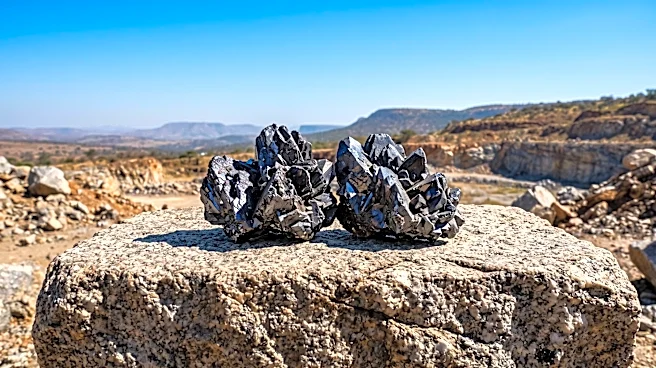
The addition of Max Martin to the Critical Minerals Security Program at CSIS is significant for U.S. policy and strategic interests. Critical minerals are essential for various advanced technologies, defense systems, and renewable energy infrastructure, making their secure supply a national security priority. Martin's background in international relations and economics, coupled with his prior experience in foreign policy, positions him to contribute valuable insights into the geopolitical and economic dimensions of critical mineral supply chains. His work will likely inform U.S. strategies to reduce reliance on potentially unstable foreign sources, diversify supply, and foster domestic production or secure partnerships. This focus is crucial for maintaining technological leadership, economic competitiveness, and national defense capabilities in an increasingly complex global environment.
What's Next?
Max Martin's immediate focus will be on contributing to the ongoing research and analysis within the Critical Minerals Security Program at CSIS. His work is expected to inform policy recommendations and public discourse on securing vital mineral resources for the United States. This could involve publishing reports, participating in expert panels, and advising policymakers on strategies to mitigate supply chain risks and enhance mineral security. The program's output will likely influence legislative efforts, international agreements, and private sector investments aimed at strengthening the U.S. position in the critical minerals landscape. Future developments may include deeper analysis of specific mineral dependencies, the economic implications of resource nationalism, and the role of technological innovation in mineral extraction and recycling.
Beyond the Headlines
The appointment of Max Martin underscores a growing recognition of critical minerals as a central issue in national security and economic policy. Beyond the immediate concerns of supply chain resilience, the broader implications touch upon environmental sustainability, ethical sourcing, and the geopolitical competition for resources. The demand for critical minerals is projected to surge with the global transition to green energy and advanced technologies, raising questions about the environmental impact of mining, labor practices in producing countries, and the potential for resource conflicts. CSIS's work in this area, with contributions from experts like Martin, will likely explore these complex interdependencies, aiming to develop holistic policy frameworks that balance economic needs with environmental and ethical considerations, shaping long-term U.S. foreign policy and industrial strategy.