
What's Happening?
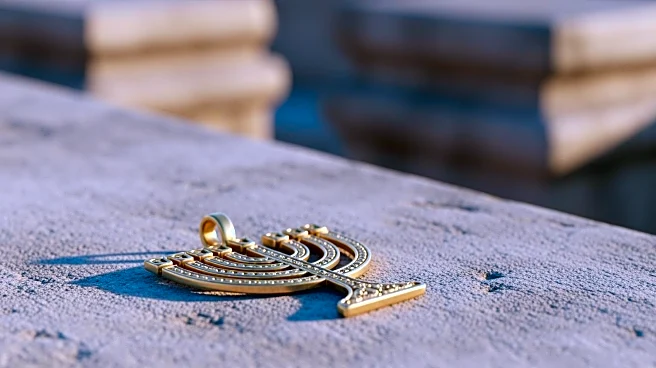
Archaeologists have discovered a rare 1,400-year-old lead pendant featuring a seven-branch menorah near the Western Wall in Jerusalem. This find, made during an excavation by the Israel Antiquities Authority,
offers new insights into Jewish life during the Byzantine period when Jews were officially banned from the city. The pendant, likely worn by a Jewish individual, symbolizes faith and identity amidst exclusion. It is one of only two known lead menorah pendants, the other being in the Walters Art Museum in Baltimore. The pendant's discovery raises questions about the presence and activities of Jews in Jerusalem during this era.
Why It's Important?
The pendant's discovery is significant as it provides tangible evidence of Jewish presence and religious expression in Jerusalem during a time of official prohibition. It highlights the resilience and determination of Jewish individuals to maintain their cultural and religious identity despite imperial edicts. This find contributes to the understanding of Jewish history and the complex dynamics of religious and cultural interactions in Byzantine Jerusalem. It also underscores the importance of archaeological research in uncovering hidden aspects of historical narratives.
What's Next?
Further analysis of the pendant and its context within the excavation site may provide additional insights into the lives of Jews in Byzantine Jerusalem. Researchers may explore the possibility of other similar artifacts in the area, which could offer a broader understanding of the period's cultural and religious landscape. The findings may prompt discussions among historians and archaeologists about the interpretation of Jewish artifacts and their significance in the context of historical restrictions on Jewish life in Jerusalem.