


What's Happening?
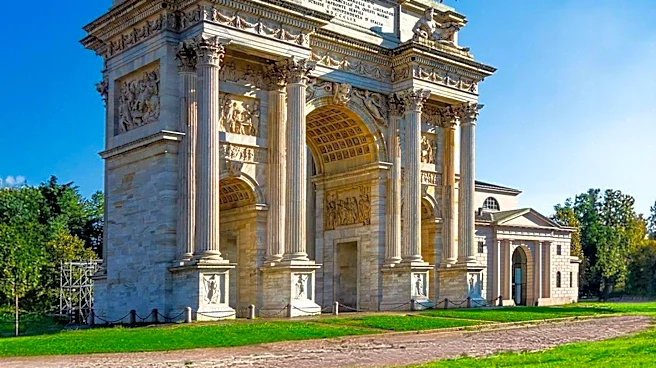
The Trump administration is moving forward with the groundbreaking for President Trump’s proposed 'triumphal arch' within the next two weeks, as announced by Interior Secretary Doug Burgum. This decision comes despite ongoing opposition, including a pending
lawsuit, concerns about the lack of congressional approval, and an incomplete review by a DC planning commission. Critics argue that the project is proceeding without adhering to necessary legal and regulatory processes. The arch is planned to be built near Washington’s Reagan National Airport, raising questions about its potential impact on air travel. While a preliminary Federal Aviation Authority (FAA) study found no risk to air travel, it recommended adding red obstruction lights to the structure. The National Capital Planning Commission has only granted preliminary approval, with final approval not expected until at least October 1, pending a Section 106 review under the National Historic Preservation Act. The Justice Department has requested the lawsuit against the arch be dismissed, citing a recent Supreme Court ruling that allowed another Trump project, the East Wing Ballroom, to proceed.
Why It's Important?
The Trump administration's decision to proceed with the triumphal arch project highlights a recurring pattern of pushing forward with development initiatives despite significant legal and regulatory hurdles. This situation underscores potential tensions between executive authority and established oversight mechanisms, including congressional approval and urban planning commissions. The project's location near a major airport also brings into focus the critical role of federal agencies like the FAA in ensuring public safety and compliance with aviation regulations. The ongoing legal challenges, particularly from groups like the National Parks Conservation Association and Public Citizen, reflect broader concerns about the preservation of national landmarks and adherence to due process in federal projects. The outcome of this dispute could set precedents for future large-scale federal construction projects, influencing how environmental, historical, and safety reviews are conducted and enforced, and potentially impacting the balance of power between different branches of government and regulatory bodies.
What's Next?
The immediate next step will be the commencement of excavation work for the triumphal arch within the next two weeks, as stated by Interior Secretary Doug Burgum. This action is likely to intensify the legal battle, with Public Citizen, representing the plaintiffs, indicating they will respond swiftly to the administration's move. The National Capital Planning Commission's final approval remains pending, with its next meeting scheduled for October 1. Before then, a crucial Section 106 review, assessing the arch's impact on historic and cultural sites, must be completed. The FAA's ongoing review, particularly regarding the need for obstruction lights, will also need to be finalized. Congressional representatives, such as Democratic Rep. Don Beyer, are expected to continue vocalizing their opposition, potentially seeking legislative intervention to halt the project. The Justice Department will continue to argue for the dismissal of the lawsuit, leveraging previous court rulings to support the administration's position.
Beyond the Headlines
This controversy extends beyond the immediate construction of an arch, touching upon fundamental questions of executive power, the integrity of regulatory processes, and the interpretation of historical preservation laws. The administration's assertion that congressional approval is not required, based on a 1925 plan for unbuilt columns, challenges established norms for federal construction projects and could redefine the scope of presidential authority in urban development. The involvement of veterans in the lawsuit, citing disruption to the sightline between the Lincoln Memorial and Arlington National Cemetery, highlights the cultural and symbolic significance of Washington D.C.'s landscape and the emotional connections citizens have to these spaces. The legal arguments surrounding 'standing' in such cases, as seen in the Supreme Court's ruling on the East Wing Ballroom, could influence future litigation against federal projects, potentially making it harder for public interest groups to challenge government actions. This situation also reflects a broader debate about the 'beautification' of national capital and who has the ultimate say in shaping its iconic appearance.