



What's Happening?
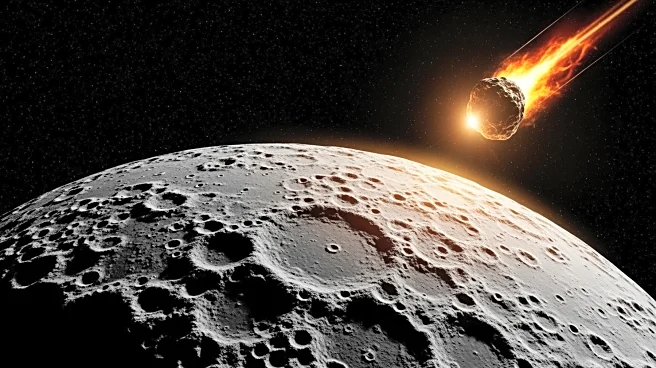
Recent research has provided new insights into the asymmetry between the near and far sides of the moon, suggesting that a colossal asteroid impact may have played a significant role. The study, led by Heng-Ci Tian from the Institute of Geology and Geophysics
at the Chinese Academy of Sciences, analyzed samples of lunar basalt brought back by China's Chang'e 6 mission. These samples, collected from the South Pole–Aitken Basin, revealed an unusual ratio of potassium isotopes, which is believed to be a relic of the giant impact that formed the basin. The impact, which occurred between 4.2 and 4.3 billion years ago, is thought to have caused intense heat and pressure, leading to the evaporation of volatile elements like potassium. This process resulted in a higher ratio of the heavier potassium-41 isotope compared to potassium-39, providing clues about the conditions during the impact and its effects on the moon's crust and mantle.
Why It's Important?
Understanding the moon's geological history is crucial for comprehending the broader dynamics of our solar system. The findings from this study not only shed light on the moon's past but also enhance our knowledge of planetary formation and evolution. The impact that created the South Pole–Aitken Basin is one of the largest known in the solar system, and its effects on the moon's isotopic composition offer valuable insights into the processes that shape celestial bodies. This research could influence future lunar exploration missions and inform the scientific community's approach to studying other planetary bodies with similar impact histories. Additionally, the study highlights the importance of international collaboration in space exploration, as the data from China's Chang'e 6 mission contributes significantly to global scientific understanding.
What's Next?
Future lunar missions may focus on further exploring the South Pole–Aitken Basin to gather more data on the moon's geological history. Scientists may also conduct comparative studies with other celestial bodies that have experienced significant impacts to better understand the universal processes at play. The findings could lead to new hypotheses about the moon's formation and the early solar system, prompting additional research and exploration. As space agencies around the world continue to plan missions to the moon, these insights will likely guide the selection of landing sites and scientific objectives, ensuring that future explorations build on the knowledge gained from this study.
Beyond the Headlines
The study's implications extend beyond lunar science, as it underscores the role of isotopic analysis in understanding planetary processes. By examining isotopic ratios, scientists can infer the conditions and events that have shaped celestial bodies over billions of years. This approach could be applied to other planets and moons, offering a powerful tool for unraveling the mysteries of the solar system. Moreover, the research highlights the potential for significant scientific discoveries through international collaboration, as data from missions like Chang'e 6 enrich the global scientific community's understanding of space.