
What's Happening?
Researchers at Oregon State University's College of Science have developed a new material, dubbed BVR-X, designed to significantly boost carbon capture technologies. This innovative material, a metal-organic
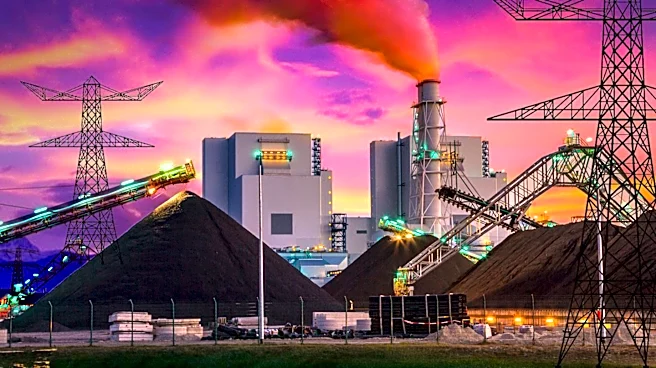
framework (MOF), addresses a critical challenge in carbon capture: the interference of water vapor in industrial flue emissions. Unlike previous MOFs, BVR-X is engineered to direct water and carbon dioxide to different regions within its pores, allowing it to continue capturing CO2 effectively even in humid conditions. This development is crucial because industrial activities, particularly the burning of fossil fuels, contribute a substantial portion of atmospheric carbon dioxide, with 30% of U.S. greenhouse gas emissions originating from industry.
Why It's Important?
The development of BVR-X by Oregon State University researchers represents a significant advancement in the global effort to achieve net-zero emission targets. Current carbon capture technologies often struggle with the presence of water vapor, which can reduce their efficiency and increase operational costs. By overcoming this hurdle, BVR-X offers a more robust and practical solution for industrial applications, potentially making carbon capture more economically viable and widespread. This innovation could have a profound impact on industries that are major emitters of CO2, such as power generation, cement production, and steel manufacturing, helping them to reduce their carbon footprint. The patent application filed by the university underscores the commercial potential and the scientific breakthrough achieved, positioning Oregon State at the forefront of sustainable energy research.
What's Next?
Following the patent application, the next steps for BVR-X will likely involve further testing and scaling up the production of the material for industrial applications. Researchers will need to conduct pilot studies in real-world industrial settings to validate its performance and durability under various operating conditions. Collaborations with industrial partners will be crucial for transitioning this laboratory-scale innovation into a commercially viable technology. The success of these efforts could lead to the widespread adoption of BVR-X in carbon capture facilities, contributing significantly to climate change mitigation. Additionally, the research team may explore further modifications to the MOF to optimize its CO2 capture capacity and selectivity, potentially leading to even more efficient and cost-effective solutions in the future.
Beyond the Headlines
This breakthrough from Oregon State University highlights the critical role of academic research in addressing pressing global challenges like climate change. The ability of BVR-X to function effectively in humid environments is a game-changer, as it tackles a fundamental limitation of existing carbon capture technologies. Beyond its immediate application, this research could inspire the development of other advanced materials with tailored properties for various environmental and industrial applications. The interdisciplinary nature of this work, combining chemistry and materials science, exemplifies how scientific collaboration can lead to innovative solutions. Furthermore, the success of such projects can attract more funding and talent to sustainable energy research, fostering a cycle of innovation that benefits society and the environment.