


What's Happening?
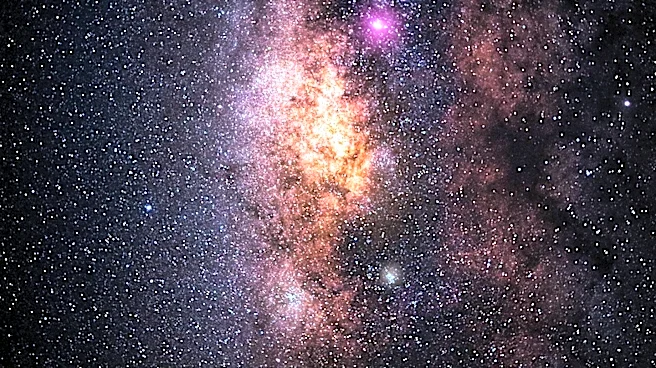
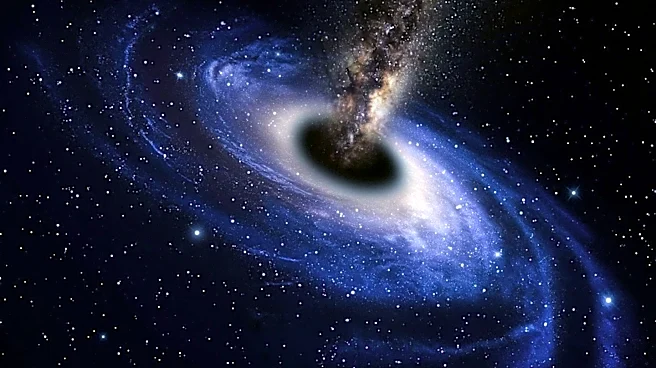
A newly discovered star, S301, is providing astrophysicists with a unique opportunity to test the limits of general relativity. S301, which orbits the supermassive black hole at the center of the Milky Way, known as Sag A*, has the shortest known orbital
period of any S-star, completing its orbit every 8.7 years. Its highly elliptical orbit brings it within 24 astronomical units of Sag A*, moving at speeds exceeding 8% of the speed of light. This extreme motion allows scientists to observe relativistic effects such as gravitational redshift and the transverse Doppler effect in a natural setting, which have previously only been observed in laboratory conditions. The star's orbit also precesses, advancing about 2° with each orbit, providing further data to test Einstein's theory of general relativity.
Why It's Important?
The study of S301 is significant as it offers a rare chance to observe and test the predictions of general relativity in a natural environment. The extreme conditions of S301's orbit around Sag A* allow for the observation of relativistic effects that are not typically visible in other celestial bodies. This research could potentially reveal discrepancies between Einstein's theory and alternative models of gravity, which could have profound implications for our understanding of the universe. Additionally, the findings could contribute to the ongoing efforts to reconcile general relativity with quantum theory, a major challenge in modern physics.
What's Next?
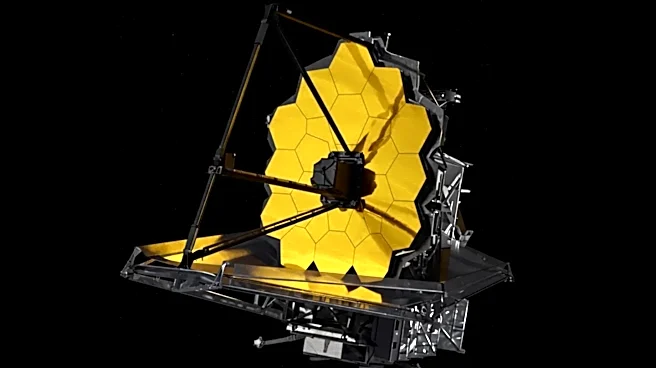
Future observations of S301 will be crucial in further testing the limits of general relativity. Large telescopes, such as the upcoming Giant Magellan Telescope, are expected to provide more precise measurements of the star's spectrum, allowing scientists to detect second- and third-order relativistic effects. These observations could help distinguish between general relativity and alternative theories of gravity. However, the dense clouds and dust surrounding the center of the Milky Way pose challenges for optical observations, necessitating the use of infrared and radio telescopes to gather data.