





What's Happening?
An international team of paleontologists from Stony Brook University, the Royal Ontario Museum, and the North Dakota Geological Survey has identified a new dinosaur species, Infernogallus jamesi, as the first known dinosaur to specialize in eating fruit.
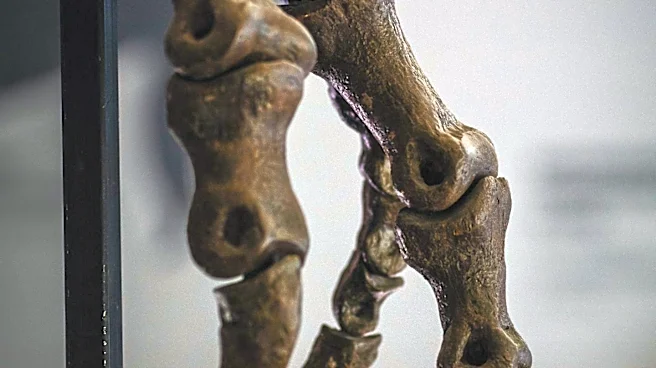
This small, bird-like, bipedal dinosaur, nicknamed 'hell chicken,' lived in North America approximately 66 million years ago during the Late Cretaceous period. Unlike most dinosaurs, Infernogallus jamesi possessed unique chewing muscles and a specialized skull structure adapted for mashing soft, fleshy fruits. Its palatal bones arched downwards into the mouth, allowing for a back-and-forth chewing motion similar to modern fruit-eating parrots, rather than the typical up-and-down bite of other dinosaurs. The discovery was made from a rare, nearly complete skull and partial skeleton found in the Hell Creek Formation, an area known for its rich dinosaur fossils, including those of T. rex and Triceratops. Infernogallus jamesi belonged to the caenagnathids, a group of toothless, feathered dinosaurs, and weighed about 12 kg, making it one of the smallest members of its group.
Why It's Important?
This discovery significantly alters our understanding of dinosaur diets and their ecological roles. Previously, paleontologists struggled to find clear links between dinosaur diversity and the evolution of flowering plants. Infernogallus jamesi provides direct evidence of a dinosaur specialized in fruit consumption, suggesting that dinosaurs may have played an unrecognized role in seed dispersal, a crucial ecological function now performed by birds, reptiles, and small mammals. The unique chewing adaptations of Infernogallus jamesi highlight the remarkable evolutionary flexibility of dinosaurs and their ability to fill diverse ecological niches. This finding also underscores the co-evolutionary relationship between dinosaurs and plants, particularly as flowering plants became more prevalent during the Cretaceous period, offering new food sources that drove specialized dietary adaptations.
What's Next?
The identification of Infernogallus jamesi opens new avenues for research into dinosaur diets and their impact on ancient ecosystems. Future studies may focus on examining other caenagnathid fossils for similar adaptations to determine if fruit-eating was more widespread within this group. Researchers will also likely investigate the fossil record of flowering plants in the Hell Creek Formation and other Late Cretaceous sites to further understand the co-evolutionary dynamics between fruit-bearing plants and their dinosaur consumers. This discovery encourages a re-evaluation of existing fossil collections, as previously overlooked anatomical features might now be recognized as indicators of specialized diets. The ongoing analysis of such finds will continue to refine our understanding of the complex food webs and ecological interactions that characterized the Mesozoic Era.
Beyond the Headlines
The 'hell chicken' challenges the popular image of dinosaurs as solely meat-eaters or large-scale herbivores, revealing a more intricate and diverse dietary landscape. This specialization for fruit-eating, evolving from carnivorous ancestors, showcases the incredible adaptive radiation within the dinosaur lineage. It also draws a fascinating parallel with modern ecosystems, where fruit-eaters are vital for plant propagation. The discovery prompts deeper questions about the extent of dinosaur influence on plant evolution and vice versa, suggesting a more dynamic and interconnected ancient world than previously imagined. This find not only enriches our scientific knowledge but also inspires a broader appreciation for the unexpected complexities of prehistoric life.