





What's Happening?
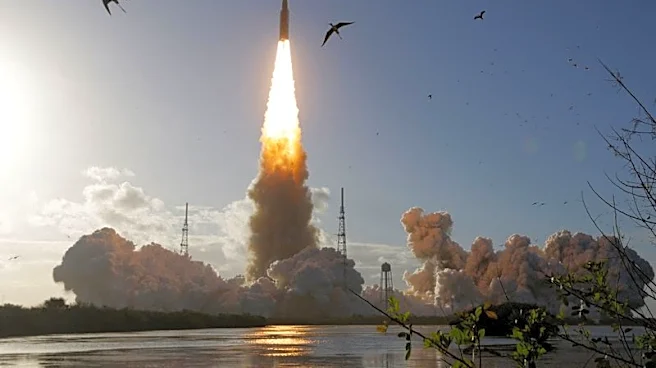
Northrop Grumman's Cygnus XL cargo spacecraft successfully launched from Cape Canaveral Space Force Station in Florida on April 11, 2026. The spacecraft, carrying over 11,000 pounds of scientific investigations and cargo, is part of the company's Commercial
Resupply Services-24 mission. The launch was executed using a SpaceX Falcon 9 rocket from Space Launch Complex 40. The Cygnus XL is expected to reach its preliminary orbit approximately 10 minutes post-launch and will deploy its solar arrays about an hour and 45 minutes later. The spacecraft's arrival at the International Space Station (ISS) is scheduled for April 13, with live coverage available on NASA+, Amazon Prime, and NASA's YouTube channel. NASA astronauts Jack Hathaway and Chris Williams will use the station's Canadarm2 robotic arm to capture the Cygnus XL at around 12:50 p.m.
Why It's Important?
The successful launch of the Cygnus XL cargo craft is crucial for maintaining the continuous operation and research activities aboard the International Space Station. The delivery of scientific investigations and essential supplies supports ongoing experiments and the well-being of the crew. This mission underscores the collaboration between NASA and private aerospace companies like Northrop Grumman and SpaceX, highlighting the growing role of commercial entities in space exploration. The resupply mission ensures that the ISS can continue to serve as a platform for scientific research, which has implications for advancements in technology, medicine, and understanding of space environments. The mission also demonstrates the reliability and efficiency of commercial resupply services, which are vital for the sustainability of long-term space missions.
What's Next?
Following the capture of the Cygnus XL by the ISS crew, the spacecraft will be installed onto the station, and its cargo will be unloaded. The scientific investigations and supplies will be distributed to various modules for use in ongoing and upcoming experiments. The success of this mission may influence future collaborations and contracts between NASA and commercial aerospace companies, potentially leading to more frequent and efficient resupply missions. Additionally, the data and results from the scientific investigations delivered by Cygnus XL could contribute to future space exploration missions and technological innovations.