






What's Happening?
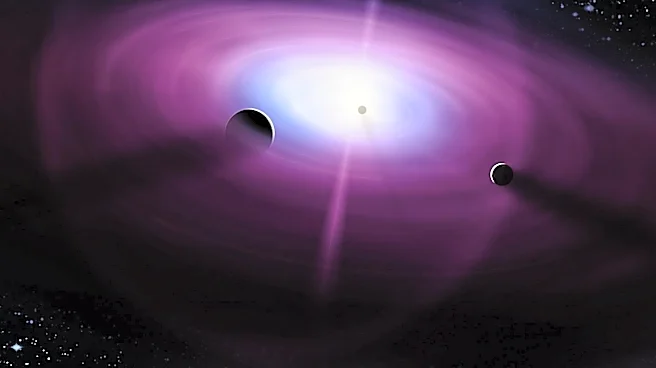
A recent study explores the Penrose process, a theoretical method to extract energy directly from rotating black holes, specifically focusing on the supermassive black hole Sgr A* at the center of the Milky Way. This process, first proposed by Roger Penrose in 1969,
differs from the usual energy generation of black holes, which occurs as a byproduct of consuming matter. The Penrose process relies on the 'ergosphere,' a region around a rotating black hole where the frame-dragging effect is so strong that anything entering it is forced to rotate with the black hole. The study suggests that if a neutron enters the ergosphere and decays into a proton, electron, and neutrino, the electron's discard can give the proton an energy boost. This interaction, particularly when combined with magnetic fields (Magnetic Penrose Process or MPP), could theoretically generate protons with energies in the petaelectronvolt (PeV) range, significantly higher than those produced by the Large Hadron Collider. These high-energy protons would then interact with surrounding gas molecules, producing intense gamma rays and high-energy neutrinos.
Why It's Important?
This research is important because it investigates a novel mechanism for energy extraction from black holes, moving beyond the conventional understanding of their energy output. If the Magnetic Penrose Process (MPP) can be confirmed, it would provide a deeper insight into the fundamental physics of black holes and their interaction with surrounding matter and energy. The potential to generate particles with PeV-level energies has significant implications for astrophysics, as it could explain the origin of some of the highest-energy cosmic rays observed. Furthermore, the study's prediction of multimessenger signals (gamma rays and neutrinos) offers a new avenue for observational astronomy. Detecting these signals would not only validate the Penrose process but also provide direct evidence of black holes losing mass, a concept that has been theorized but not yet directly observed through this mechanism. This could lead to a re-evaluation of black hole dynamics and their role in galactic energy budgets.
What's Next?
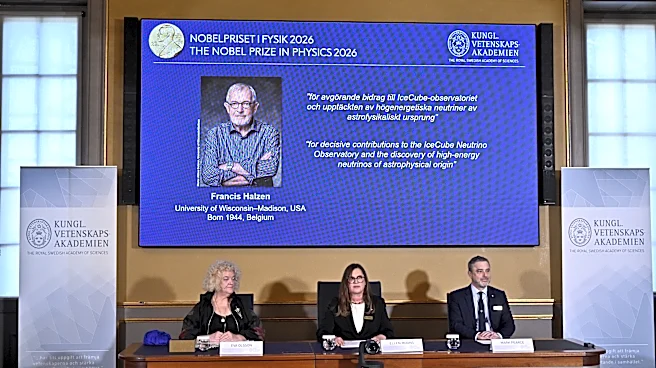
The study indicates that current technology is not yet capable of observing the predicted gamma-ray and neutrino signals from the Magnetic Penrose Process due to their faintness. However, the researchers anticipate that upgraded versions of existing observatories, such as the High-Altitude Water Cherenkov (HAWC) observatory and the new iteration of the IceCube Neutrino Observatory in Antarctica, could potentially detect these signals in the near future. The next steps involve the continued development and enhancement of these advanced astronomical instruments. If these upgraded observatories succeed in detecting the predicted multimessenger signals, it would provide crucial empirical evidence for the Penrose process and its variations. This would then open doors for further theoretical and observational studies into the efficiency and prevalence of such energy extraction mechanisms in the universe, potentially leading to a more complete understanding of black hole physics and high-energy astrophysical phenomena.
Beyond the Headlines
Beyond the immediate scientific implications, the exploration of the Penrose process touches upon profound questions regarding the nature of energy, mass, and spacetime. The concept of a black hole losing mass by imparting energy to external particles challenges the intuitive notion of black holes as ultimate cosmic sinks. It highlights the complex and often counter-intuitive aspects of general relativity and quantum mechanics at extreme gravitational environments. The theoretical possibility of 'dumping trash' into a black hole's ergosphere to gain energy, while currently a thought experiment, sparks imagination about future advanced civilizations and their potential energy sources. This research also underscores the ongoing quest to unify our understanding of gravity with quantum mechanics, as phenomena within the ergosphere involve both classical relativistic effects and quantum particle interactions. The pursuit of detecting these subtle signals pushes the boundaries of human ingenuity in instrument design and data analysis, reflecting a deeper human drive to comprehend the most enigmatic objects in the cosmos.