







What's Happening?
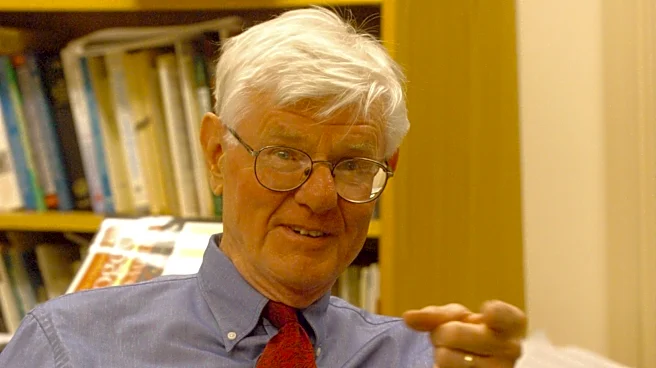
Gordon S. Wood, a renowned historian known for his influential works on the American Revolution, has passed away at the age of 92. Wood died after being struck by a car in a supermarket parking lot in East Providence, Rhode Island. A professor emeritus
at Brown University, Wood was celebrated for his scholarly contributions, including 'The Creation of the American Republic' and 'The Radicalism of the American Revolution,' which won the Pulitzer Prize in 1993. His work has been a cornerstone in the study of America's early years of independence, providing a narrative that has been both influential and debated among historians. Despite his acclaim, Wood faced criticism from some younger academics who felt his work did not adequately address the roles of slaves, women, and Indigenous people in history.
Why It's Important?
Gordon S. Wood's death marks the loss of a pivotal figure in American historical scholarship. His work has shaped the understanding of the American Revolution and its aftermath, influencing both academic circles and public discourse. Wood's interpretations have been foundational in discussions about the formation of the United States and the legacy of its founding documents. His passing may prompt a reevaluation of his contributions and the ongoing debates about historical narratives, particularly regarding inclusivity and representation in historical scholarship. The impact of his work extends beyond academia, as it has informed cultural and political discussions about America's origins and identity.
What's Next?
In the wake of Wood's passing, there may be renewed interest in his works and the debates they sparked. Historians and scholars might revisit his interpretations, potentially leading to new discussions or publications that reassess his legacy. Institutions like Brown University and other academic bodies may hold events or publish retrospectives to honor his contributions. Additionally, the ongoing discourse about how history is taught and understood in the U.S. could be influenced by reflections on Wood's work, particularly in the context of current debates about historical inclusivity and representation.
Beyond the Headlines
Gordon S. Wood's career highlights the tension between traditional historical narratives and newer approaches that emphasize diverse perspectives. His work, while celebrated, also faced criticism for its perceived lack of focus on marginalized groups. This reflects broader challenges in the field of history, where scholars strive to balance established narratives with the need for more inclusive accounts. Wood's legacy may serve as a catalyst for further exploration of how history is written and taught, encouraging a more nuanced understanding of America's past that acknowledges both its achievements and its complexities.