





What's Happening?
NASA is set to unveil the Nancy Grace Roman Space Telescope, a next-generation observatory designed to survey the universe with a field of view 100 times larger than the Hubble Space Telescope. The Roman Telescope aims to explore the large-scale structure
of galaxies and stars, addressing questions about the universe's formation, evolution, and expansion, particularly concerning dark matter and dark energy. The telescope will also conduct a 'Galactic Bulge Time-Domain Survey' to search for exoplanets using gravitational lensing. The unveiling event will take place at NASA's Goddard Spaceflight Center in Greenbelt, Maryland, with key figures such as NASA Administrator Jared Isaacman and Roman telescope project manager Jamie Dunn discussing the telescope's progress and science plans.
Why It's Important?
The Roman Space Telescope represents a significant advancement in astronomical research, offering a broader view of the universe compared to its predecessor, the Hubble Space Telescope. By focusing on large-scale cosmic structures and phenomena like dark matter and dark energy, Roman could provide critical insights into the fundamental forces shaping the universe. Its ability to detect exoplanets through gravitational lensing could expand our understanding of planetary systems beyond our own, potentially identifying new worlds that could harbor life. This telescope's launch and subsequent research could influence future space exploration missions and contribute to the scientific community's efforts to unravel the mysteries of the cosmos.
What's Next?
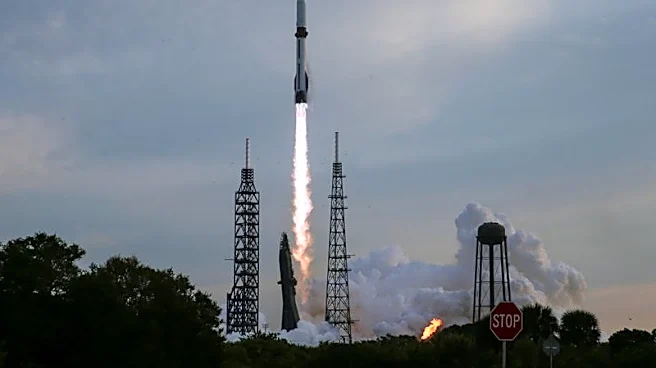
Following its unveiling, the Roman Space Telescope will undergo final prelaunch testing at Goddard before being shipped to NASA's Kennedy Space Center in Florida. It is scheduled to launch aboard a SpaceX Falcon Heavy rocket between autumn 2026 and May 2027. Once operational, Roman will begin its extensive surveys of the universe, with astronomers eagerly anticipating the data it will provide. The findings from Roman's observations could lead to new theories and models about the universe's structure and evolution, potentially guiding future space missions and research initiatives.