








What's Happening?
A recent study published in the Science journal suggests that a global coalition of countries could significantly reduce greenhouse gas emissions and generate substantial public revenue by adopting carbon pricing across four major industrial sectors:
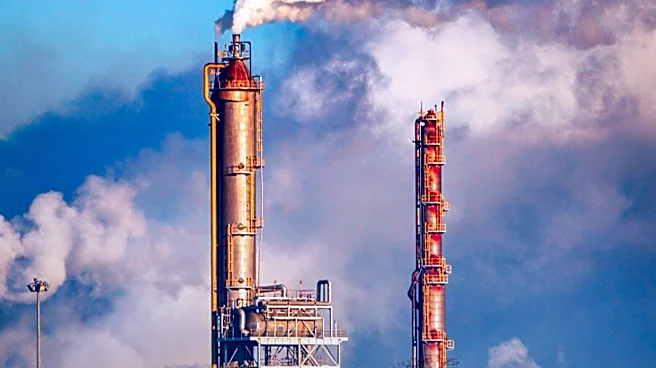
iron, steel, aluminum, cement, and fertilizers. These industries collectively account for approximately 20% of global greenhouse gas emissions. The proposed coalition would involve member countries introducing carbon pricing for these industries domestically and applying carbon charges to imports from non-member countries. This approach aims to address 'carbon leakage,' where companies relocate production to countries with less stringent climate policies, and the 'free-rider' problem, where some countries benefit from global emission reductions without contributing equally. The study, titled 'Building a scalable climate coalition for heavy industry,' highlights that such a system could also incorporate varying carbon prices based on countries' income levels, allowing lower-income nations to participate without facing immediate, prohibitive costs.
Why It's Important?
This initiative is important for the U.S. as it could influence international trade dynamics and domestic industrial policy. If the U.S. were to join such a coalition, it would likely lead to the implementation of carbon pricing mechanisms in its heavy industries, potentially increasing operational costs for manufacturers in the iron, steel, aluminum, cement, and fertilizer sectors. Conversely, U.S. industries that are already more carbon-efficient could gain a competitive advantage. The application of carbon border adjustments would also impact U.S. imports and exports, potentially leveling the playing field for domestic producers against those from countries with less stringent environmental regulations. For U.S. consumers, these changes could translate into higher prices for goods produced using these materials, but also contribute to a more sustainable global economy. The framework's flexibility, allowing for differentiated carbon prices based on income levels, could also shape how the U.S. engages with developing nations on climate policy, fostering broader international cooperation.
What's Next?
The study's findings lay the groundwork for potential international discussions and policy development regarding a global climate coalition. The next steps would likely involve diplomatic efforts to garner support from key industrial nations, including the U.S., to explore the feasibility and implementation details of such a carbon pricing system. Stakeholders, including industry leaders, environmental organizations, and policymakers, will need to analyze the economic and environmental impacts of joining or forming such a coalition. The U.S. government would need to consider legislative actions to enable domestic carbon pricing and border adjustment mechanisms, which could face significant political and economic debate. The success of this initiative would depend on the willingness of major economies to coordinate on climate and trade policies, potentially leading to new international agreements or amendments to existing trade frameworks.
Beyond the Headlines
Beyond the immediate economic and environmental implications, this proposal touches upon deeper issues of global governance and equity in climate action. The concept of differentiated carbon pricing based on income levels acknowledges the historical responsibility of developed nations and the varying capacities of developing countries to implement costly climate policies. This could foster a more inclusive approach to climate change mitigation, moving beyond traditional 'one-size-fits-all' solutions. Furthermore, by linking trade policy with climate objectives, the coalition aims to internalize the environmental costs of production, potentially shifting global supply chains towards more sustainable practices. This could also lead to a re-evaluation of international trade agreements, emphasizing environmental sustainability alongside economic efficiency. The initiative could also spur innovation in green technologies within heavy industries as companies seek to reduce their carbon footprint to remain competitive in a carbon-priced global market.