





What's Happening?
A US Army commander, Captain Allan W. Watson of Blackhawk Company, 2nd Battalion, 7th Cavalry Regiment, has shared insights from a recent combat training exercise in Germany where his troops faced Ukrainian soldiers experienced in drone warfare. The exercise,
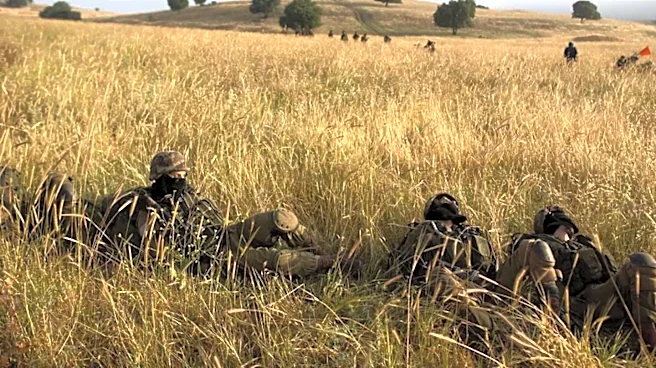
held at Hohenfels Training Area, pitted Watson's soldiers against the 1st Battalion, 4th Infantry Regiment, supported by Ukraine's 412 Regiment, known as 'Nemesis.' The Ukrainian unit brought real combat experience with drones, presenting a significant challenge. Watson noted that persistent drone surveillance exposed their movements and put armored vehicles at risk. However, his soldiers adapted by changing how they used their armored vehicles, hiding Bradleys in terrain, leveraging natural cover, avoiding predictable routes, and considering their visibility to overhead drones. Despite losses of Bradleys and tanks, which Watson considered expected in such high-pressure simulations, he concluded that armor still provides crucial mobility, protection, and firepower when used adaptively in a drone-saturated environment. He emphasized that while drones could identify them from above, ground troops were still necessary to exploit that information.
Why It's Important?
This report is highly significant for the future of military strategy and equipment development, particularly in the context of modern warfare characterized by widespread drone use. Since the beginning of the Ukraine war, there has been considerable debate about the vulnerability and relevance of heavy armor like tanks and infantry fighting vehicles against cheap, pervasive drones. Captain Watson's account offers a nuanced perspective, suggesting that while drones pose a significant threat, they do not render armor obsolete. Instead, it highlights the critical need for adaptation in tactics, training, and doctrine. The exercise demonstrates that with proper concealment, terrain exploitation, and unpredictable movement, armored units can still be effective. This has implications for defense spending, military research and development, and the training of ground forces, reinforcing the idea that combined arms operations, where armor, infantry, and counter-drone measures work in concert, remain essential. It also underscores the value of learning from real-world combat experience, as provided by the Ukrainian forces.
What's Next?
The lessons learned from this training exercise will likely influence future US Army doctrine, training methodologies, and equipment procurement. There will likely be an increased emphasis on developing and integrating counter-drone capabilities within armored units, as well as refining tactics for operating in drone-heavy environments. This could include investments in electronic warfare systems, camouflage technologies, and advanced situational awareness tools. Future training exercises will probably incorporate more sophisticated drone threats and require units to demonstrate adaptive tactics. The debate over the role of armor will continue, but this report suggests a path forward where armor remains a vital component of ground forces, provided it is used intelligently and adaptively. Military planners will continue to analyze the interplay between traditional armored warfare and emerging drone technologies to ensure forces are prepared for future conflicts.
Beyond the Headlines
This exercise points to a deeper evolution in military thinking, moving beyond a simple 'armor vs. drone' dichotomy to a more integrated approach to modern combat. It highlights the enduring importance of human ingenuity and adaptability on the battlefield, even in the face of advanced technology. The need for ground reconnaissance to exploit drone intelligence underscores that technology, while powerful, does not entirely replace traditional military functions. Ethically, the proliferation of drones raises questions about the nature of warfare, the protection of combatants, and the potential for increased automation in conflict. Legally, the use of drones and counter-drone measures continues to evolve within international humanitarian law. Culturally, this shift demands that military personnel become more technologically adept while retaining core soldiering skills, fostering a new generation of 'hybrid' warriors capable of operating across multiple domains of warfare. This ongoing adaptation will shape military culture and training for decades to come.