





What's Happening?
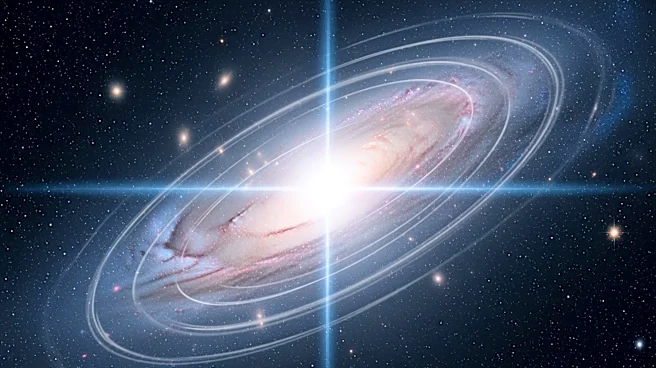
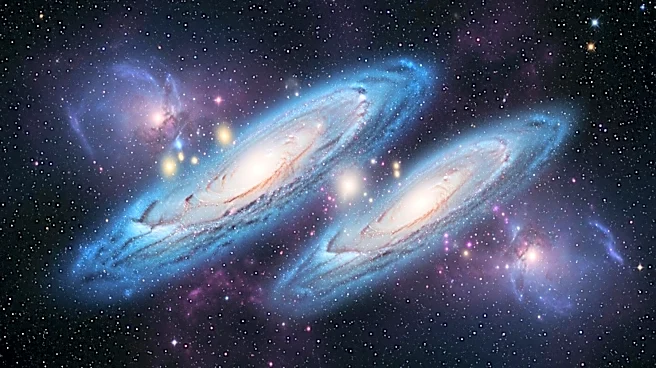
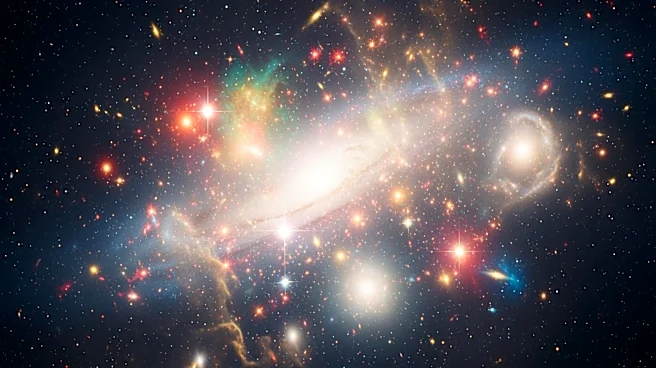
Astronomers have identified a group of stars within the Milky Way that may have originated from a smaller galaxy, nicknamed 'Loki,' which merged with our galaxy approximately 10 billion years ago. This discovery was made by studying the chemical composition
and motion of 20 very-metal-poor stars orbiting close to the galactic disk. These stars, which are unusually close to the Milky Way's disk, suggest a past merger event. The study, published in the Monthly Notices of the Royal Astronomical Society, indicates that these stars could be remnants of one of the earliest mergers in the Milky Way's history. The research was led by Federico Sestito, an astrophysicist at the University of Hertfordshire, who noted that Loki might have been among the first small galaxies formed in the young universe.
Why It's Important?
This discovery is significant as it provides insights into the formation and evolution of the Milky Way. Understanding the history of galaxy mergers helps astronomers piece together the processes that shaped our galaxy. The presence of these metal-poor stars near the galactic disk challenges previous assumptions about the distribution of such stars, which are typically found in the galactic halo. This finding could lead to a reevaluation of models regarding the Milky Way's formation and the role of early galaxy mergers. The study also highlights the potential for future research to uncover more about the early universe and the formation of large galaxies from smaller systems.
What's Next?
Further observations are needed to confirm the findings and better understand the differences between the stars from Loki and other parts of the Milky Way. Upcoming advanced spectroscopic facilities will allow astronomers to observe hundreds of stars, providing high-quality data on their trajectories and chemical abundances. This will help refine models of the Milky Way's formation and potentially reveal more hidden systems within the galaxy. The research team plans to continue exploring the chemical signatures of low-metallicity stars in the Milky Way disk to gain deeper insights into the galaxy's early history.