
What's Happening?
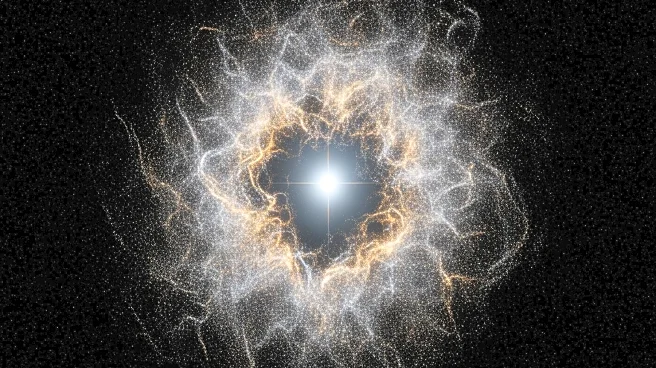
Astronomers have identified a colossal cloud of evaporated metals surrounding the star J0705+0612, located approximately 3,000 light-years from Earth. This cloud, about 200 million kilometers wide, dimmed
the star for nine months. The cloud is held together by the gravity of an unknown massive object, possibly a giant planet or a low-mass star, and likely formed from a collision between two planets. The discovery, made using the Gemini South, Apache Point, and Magellan telescopes, marks the first time scientists have measured the motion of gas within such a structure. The findings suggest that even mature planetary systems, around 2 billion years old, can experience catastrophic events that significantly impact their evolution.
Why It's Important?
This discovery is significant as it challenges the understanding of planetary system stability over time. The presence of such a massive cloud in a mature system indicates that large-scale collisions can still occur, reshaping the system's architecture. This has implications for the study of planetary formation and evolution, suggesting that systems similar to our own could undergo dramatic changes long after their initial formation. The ability to measure gas motion within the cloud provides new insights into the dynamics of such structures, potentially influencing future research on planetary system development and stability.
What's Next?
Further observations and studies are needed to determine the exact nature of the massive object holding the cloud together. Understanding whether it is a giant planet or a low-mass star will provide more clarity on the system's dynamics. Additionally, researchers may explore similar phenomena in other star systems to assess the prevalence and impact of such events. This could lead to a broader understanding of how planetary systems evolve and the potential for similar occurrences in other parts of the galaxy.