


What's Happening?
Brazil's upcoming presidential election in October 2026 is being significantly impacted by a far-reaching corruption scandal involving Banco Master. The scandal, which emerged in November 2025 with the Central Bank liquidating Banco Master due to a R$50
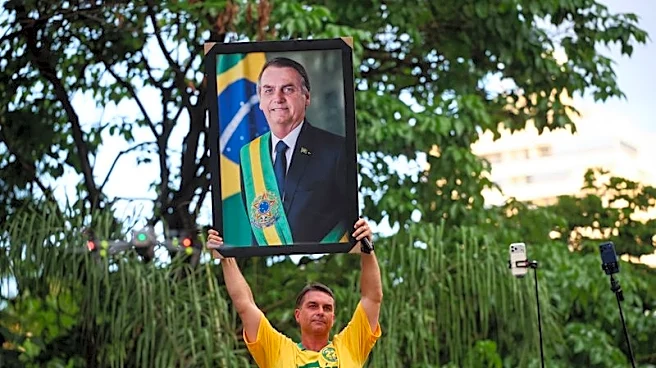
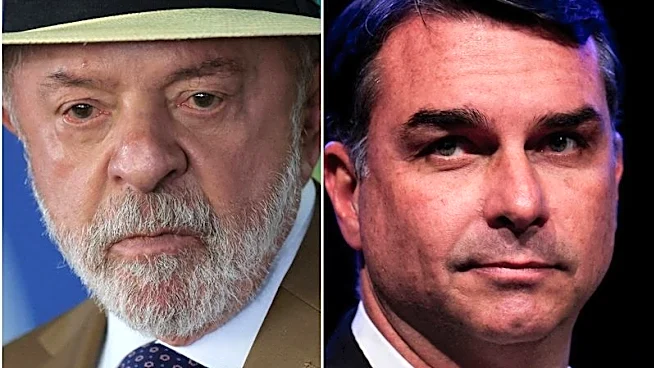
billion fraud, has now implicated high-profile political figures. Justice Alexandre de Moraes of the Supreme Court, who previously convicted Jair Bolsonaro for a 2023 coup attempt, is under scrutiny. His wife, Viviane Barci de Moraes, secured a $25 million legal contract for her firm to represent Banco Master. Allegations suggest Justice Moraes himself edited contract terms and contacted the Central Bank president regarding the bank's fate, and leaked messages imply he acted as Daniel Vorcaro's personal lawyer. Additionally, Senator Flávio Bolsonaro, son of former President Jair Bolsonaro and a leading presidential candidate, is under formal investigation. Leaks revealed he negotiated $24 million from Vorcaro to finance a biographical film about his father, undermining his anti-corruption stance. This scandal has narrowed the polling gap between current President Luiz Inácio Lula da Silva and Flávio Bolsonaro, making the election a toss-up.
Why It's Important?
The Banco Master corruption scandal is profoundly impacting the 2026 Brazilian presidential election, a critical event for the country's future direction, including its security policy and the Supreme Court's composition. The involvement of Justice Alexandre de Moraes, a key figure in the conviction of former President Jair Bolsonaro, raises serious questions about judicial integrity and potential political influence within Brazil's highest court. This could erode public trust in the judiciary and the electoral process. For the U.S., the outcome of this election is significant due to the potential for shifting alliances and security cooperation. A Flávio Bolsonaro victory could lead to a closer alignment with the U.S., particularly under a Trump administration, potentially expanding security cooperation through initiatives like the 'Shield of the Americas.' This would involve increased intelligence sharing, equipment, and joint operations to combat organized crime. Conversely, a Lula da Silva victory would likely maintain a more independent foreign policy. The scandal's impact on the election's competitiveness also highlights the fragility of democratic institutions in the face of corruption and the potential for political instability in a major South American power, which has broader implications for regional stability and U.S. foreign policy interests.
What's Next?
The immediate focus will be on the first round of the Brazilian presidential election on October 4, 2026. Given the tight polling margins, a runoff election on October 25 is highly probable, as neither President Lula da Silva nor Senator Flávio Bolsonaro is expected to secure a majority. Flávio Bolsonaro's position is anticipated to strengthen in a second round, as he is likely to attract voters from other right-leaning candidates. The investigations into the Banco Master scandal, particularly those involving Justice Alexandre de Moraes and Flávio Bolsonaro, are expected to continue and could yield further developments, potentially influencing public opinion and the election's outcome. The consistent questioning of Brazil's electronic voting machines by Flávio Bolsonaro, despite official rejections, raises concerns about potential post-election unrest, reminiscent of the 2022 cycle. The next president will also have the opportunity to reshape the Supreme Court, with one vacant spot and three justices set to retire in the next four years, making the election's judicial implications substantial. The U.S. will closely monitor these developments, especially regarding potential shifts in U.S.-Brazil security cooperation and trade relations.
Beyond the Headlines
The Banco Master scandal and its political ramifications expose deeper vulnerabilities within Brazil's democratic framework, particularly the interplay between political power, judicial authority, and financial corruption. The allegations against Justice Alexandre de Moraes, a figure central to upholding the rule of law, highlight the potential for high-level corruption to undermine public confidence in governmental institutions. This erosion of trust can fuel populist sentiments and anti-establishment narratives, as seen in the continued support for figures like Flávio Bolsonaro despite corruption allegations. The scandal also underscores the persistent challenge of financial malfeasance in emerging economies and its capacity to destabilize political landscapes. Furthermore, the narrative of a 'coup d'état attempt' in 2023, referenced in relation to Jair Bolsonaro's conviction, suggests a broader struggle over democratic norms and the potential for political polarization to escalate into challenges to constitutional order. The U.S. response to these events, whether through diplomatic engagement or security cooperation, will reflect its commitment to democratic stability in the region and its strategic interests in a key South American partner.