






What's Happening?
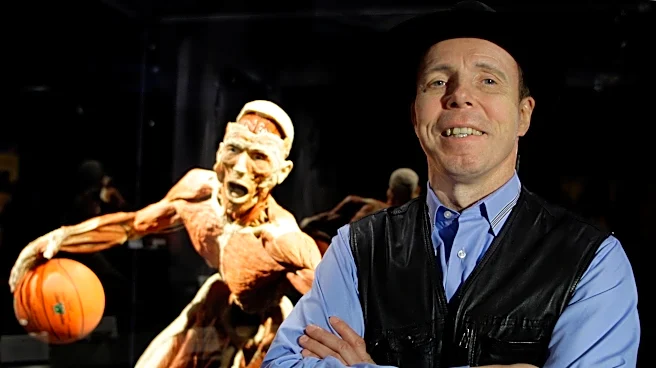
Gunther von Hagens, the German anatomist who pioneered the plastination technique and created the 'Body Worlds' exhibitions, has died at 81 in Heidelberg, Germany. His death followed a cerebral hemorrhage, and he had been living with Parkinson's disease
for nearly two decades. Von Hagens' plastination process, developed in 1977, involves replacing bodily fluids with plastics to preserve bodies in lifelike poses for educational purposes. His exhibitions, which have been viewed by over 58 million people globally, aimed to educate the public about anatomy and health. Despite drawing large audiences, the exhibitions faced criticism from religious groups and ethicists.
Why It's Important?
Von Hagens' work has had a profound impact on public engagement with science and anatomy, making complex biological concepts accessible to a broad audience. His exhibitions have sparked important ethical debates about the display of human remains and the boundaries of scientific exploration. The continuation of his work through the Institute for Plastination ensures that his innovative approach to education and public engagement will persist, influencing future generations of scientists and educators.
What's Next?
The Institute for Plastination, led by von Hagens' wife, Angelina Whalley, will continue to operate and expand his legacy. The institute plans to fulfill von Hagens' wish to have his body plastinated, although the specifics of its display are yet to be determined. The ongoing 'Body Worlds' exhibitions will likely continue to attract public interest and provoke discussions on the ethical implications of plastination.
Beyond the Headlines
Von Hagens' work challenges traditional views on death and the human body, encouraging a deeper understanding of human anatomy and mortality. The plastination technique also holds potential for advancements in medical education, offering detailed anatomical models for study. The ethical debates surrounding his work highlight the need for ongoing dialogue about consent and the use of human remains in scientific and educational contexts.