



What's Happening?
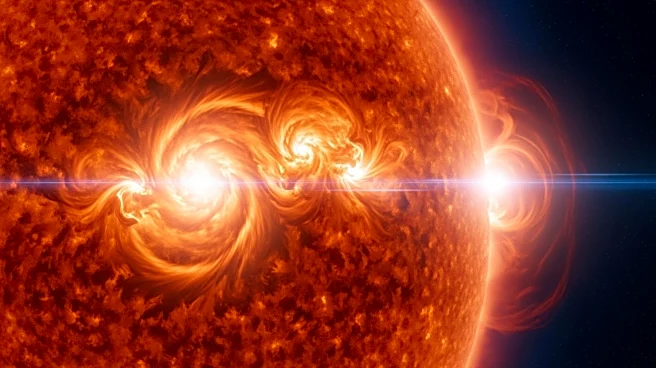
The European Space Agency's Solar Orbiter mission has provided unprecedented observations of a highly active solar region, NOAA 13664, between April and July 2024. This region, one of the most intense in two decades, triggered significant geomagnetic
storms, visible as auroras as far south as Switzerland. The Solar Orbiter, launched in 2020, follows a wide orbit around the Sun, allowing it to observe areas not visible from Earth. By combining data from the Solar Orbiter and NASA's Solar Dynamics Observatory, researchers were able to track NOAA 13664 continuously for 94 days, marking a milestone in solar physics. This extended observation revealed the evolution of the region's magnetic fields, culminating in a powerful solar flare on May 20, 2024.
Why It's Important?
The observations of NOAA 13664 have significant implications for understanding and predicting space weather. Solar storms, like those caused by NOAA 13664, can disrupt power grids, communication systems, and satellites, posing risks to modern technology. For instance, heightened solar activity in February 2022 led to the loss of 38 Starlink satellites. The disruptions caused by NOAA 13664 in May 2024 affected digital agriculture, leading to economic losses. Understanding solar activity is crucial for mitigating these impacts and protecting sensitive technologies. The research aims to improve space weather forecasts, which could help safeguard infrastructure and reduce economic risks associated with solar storms.
What's Next?
Researchers are working on improving predictions of solar storms and their effects on Earth. The European Space Agency is developing a new space probe, Vigil, dedicated to enhancing the understanding of space weather, with a planned launch in 2031. This mission aims to provide more accurate forecasts, helping to protect satellites, power systems, and other technologies from solar storm disruptions. As scientists continue to study solar activity, they hope to better predict the timing and strength of solar eruptions, ultimately reducing the risks posed by space weather to modern society.
Beyond the Headlines
The study of solar activity not only has technological implications but also highlights the interconnectedness of space and Earth. The ability to observe solar regions across multiple rotations offers insights into the Sun's magnetic dynamics, which are crucial for understanding its influence on the solar system. This research underscores the importance of international collaboration in space exploration, as data from multiple spacecraft are combined to achieve comprehensive observations. The ongoing development of space weather forecasting tools reflects a growing recognition of the Sun's impact on Earth's environment and the need for preparedness in the face of natural cosmic phenomena.