





What's Happening?
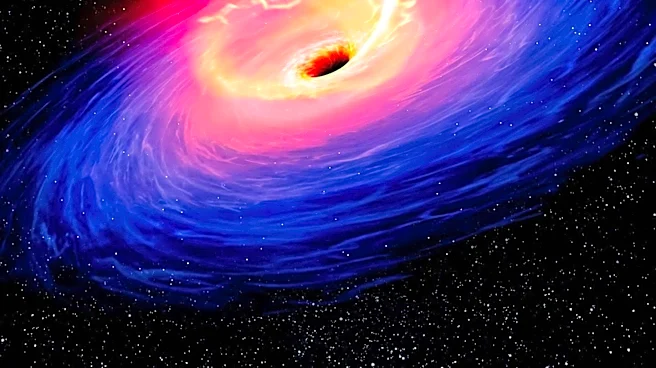
NASA describes a black hole as a region in space where gravity is so intense that nothing, not even light, can escape once it crosses a boundary called the event horizon. These are not empty voids but rather immense concentrations of matter packed into
incredibly small spaces. Black holes are formed when massive stars collapse at the end of their lives. Astronomers have successfully photographed two black holes: one in the galaxy M87 in 2019 and Sagittarius A* at the center of our Milky Way in 2022, though these images show the glowing gas and shadow, not the black hole itself. NASA clarifies that black holes do not 'roam space swallowing everything' and are not literal holes, but rather extremely dense objects whose gravitational pull is inescapable within their event horizon.
Why It's Important?
Understanding black holes is crucial for comprehending the fundamental laws of physics, particularly general relativity, under extreme conditions. Their immense gravitational pull and the concept of the event horizon challenge our everyday understanding of space and time. The study of black holes helps scientists explore the origins and evolution of galaxies, as supermassive black holes reside at the center of nearly every large galaxy, including our own. The ability to photograph black holes, even indirectly, marks a significant milestone in observational astronomy, providing visual evidence for these theoretical constructs and allowing for direct testing of Einstein's theories. Dispelling common misconceptions about black holes, such as their 'swallowing' nature, is also important for public scientific literacy.
What's Next?
Astronomers continue to study black holes through various indirect methods, including observing the behavior of nearby stars, detecting X-rays from accretion disks, analyzing gravitational waves from black hole mergers, and observing gravitational lensing. Future missions and advanced telescopes will aim to gather more detailed data on black holes of different sizes and types, including the elusive intermediate-mass black holes. Research will also focus on understanding the mysterious origins of supermassive black holes and the theoretical concept of primordial black holes. Continued observations will refine our understanding of their properties, how they interact with their environments, and their role in the cosmic structure.
Beyond the Headlines
The study of black holes pushes the boundaries of human knowledge, touching upon profound philosophical questions about the nature of reality, time, and existence. The singularity at the heart of a black hole, where matter is theorized to be crushed to infinite density, remains a point where current physics breaks down, hinting at the need for a unified theory of quantum gravity. The concept of Hawking radiation, which suggests black holes can slowly evaporate over vast timescales, links quantum mechanics with general relativity. Black holes serve as natural laboratories for testing extreme physics, potentially revealing new laws of the universe that are not observable under less extreme conditions. Their existence challenges our intuition and expands our cosmic perspective.