


What's Happening?
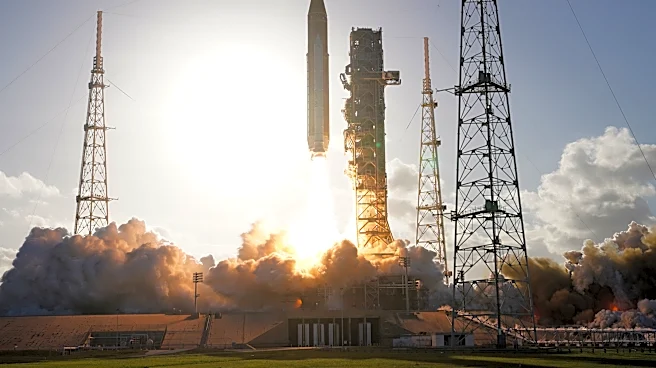
NASA has launched the Artemis II mission, marking the first crewed test flight of the Orion spacecraft, which aims to return humans to deep space for the first time in over 50 years. The mission, which began on April 1, 2026, involves a 10-day journey
around the Moon and back to Earth. The crew consists of NASA astronauts Commander Reid Wiseman, Pilot Victor Glover, and Mission Specialist Christina Koch, along with Canadian Space Agency astronaut Jeremy Hansen. Early in the mission, the crew encountered a minor issue with the spacecraft's toilet system, which was quickly resolved by mission control. A significant part of the mission includes a proximity operations demonstration, where the crew manually maneuvered the Orion spacecraft close to another object using only onboard sensors, a critical skill for future lunar missions.
Why It's Important?
The Artemis II mission is a pivotal step in NASA's efforts to return humans to the Moon and eventually conduct more ambitious missions, such as landing on Mars. By testing the Orion spacecraft's capabilities in deep space, NASA is gathering essential data to ensure the safety and success of future missions. The proximity operations demonstration is particularly crucial, as it tests the crew's ability to navigate without GPS, a necessary skill for docking with the planned Gateway lunar station and other lunar operations. The mission's success could pave the way for sustained human presence on the Moon, which has significant implications for scientific research, international collaboration, and the future of space exploration.
What's Next?
Following the successful completion of the Artemis II mission, NASA will analyze the data collected to refine the Orion spacecraft's systems and procedures. The next steps include preparing for Artemis III, which aims to land astronauts on the lunar surface. This mission will further test the technologies and strategies developed during Artemis II, including the proximity operations and navigation techniques. The success of these missions will be critical in establishing a sustainable human presence on the Moon and setting the stage for future exploration of Mars and beyond.