


What's Happening?
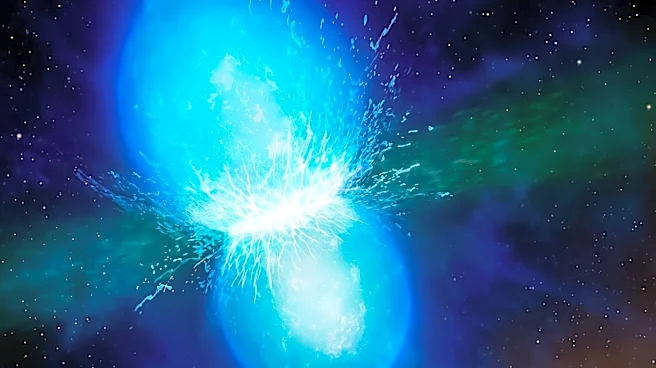
Scientists have detected an incredibly bright burst of radio waves, dubbed FRB 20240304B, that originated more than 10 billion years ago in a distant galaxy. This fast radio burst (FRB) lasted only a few milliseconds and was tracked back to a small galaxy filled
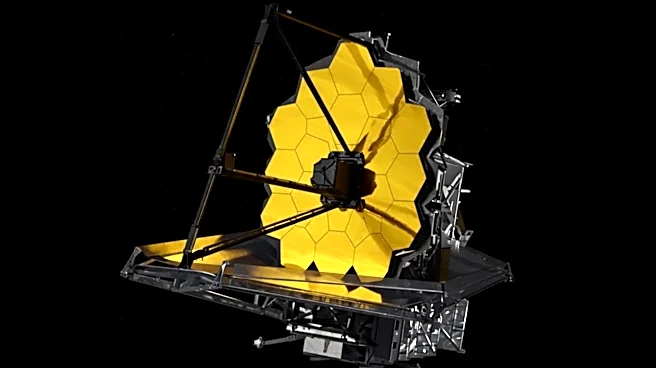
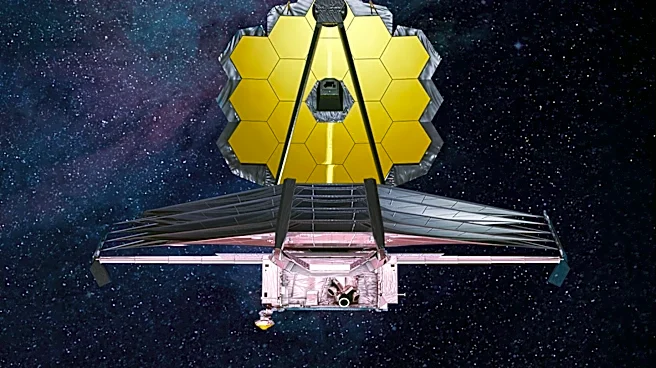
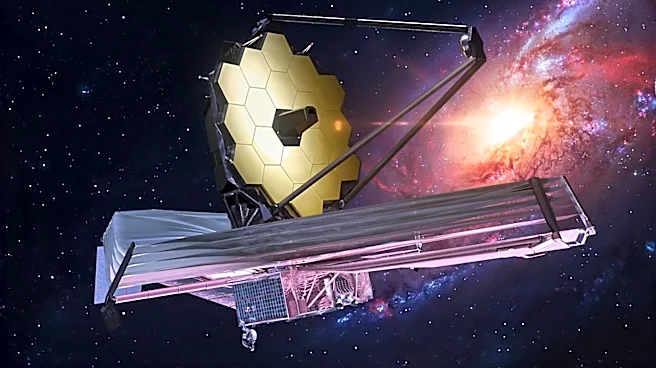
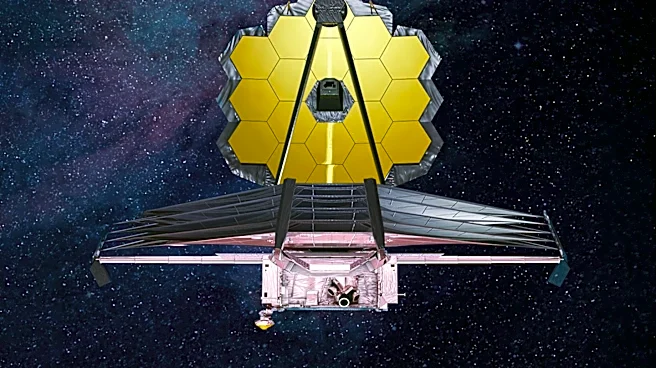
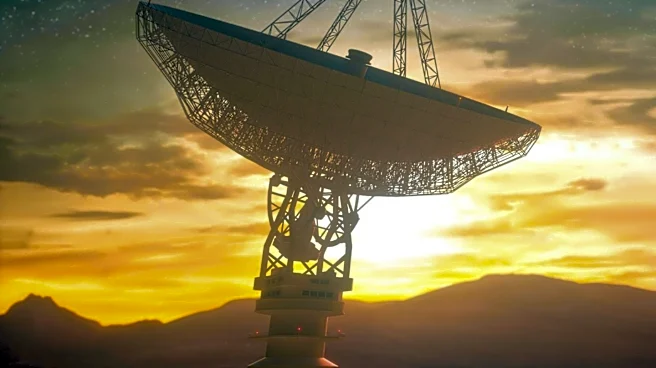
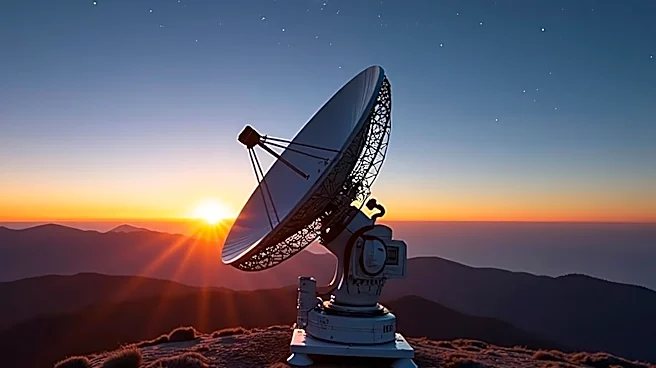
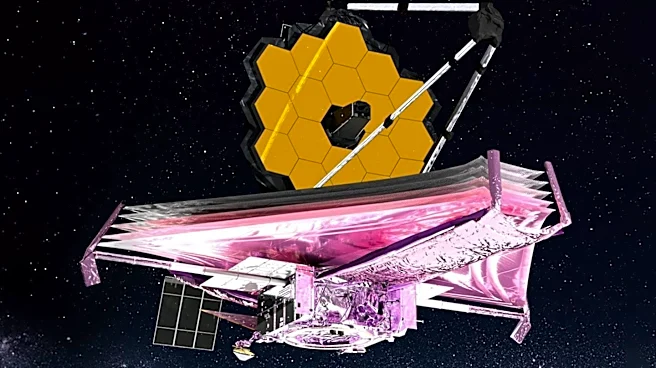
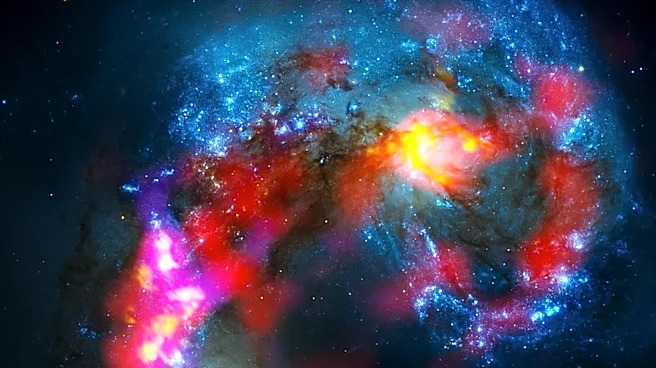
with many young stars, existing when the universe was approximately one-fifth of its current age. The MeerKAT radio telescope in South Africa, utilizing the MeerTRAP system, initially detected the burst. Due to the significant amount of dispersion observed, indicating a long journey through electrically charged material, researchers were able to calculate its immense distance. The James Webb Space Telescope (JWST) was then used to identify the faint host galaxy, which was found to be surprisingly small, containing only about 10 million times the mass of our Sun, and actively forming stars with low metal content. This discovery marks the most distant FRB whose host galaxy has been identified to date.
Why It's Important?
This discovery is crucial for understanding the early universe and the origins of fast radio bursts. By identifying the host galaxy of FRB 20240304B, scientists gain a new piece of the puzzle in determining which types of galaxies and stellar environments produce these powerful cosmic events. The characteristics of the host galaxy, being small and young, align with theories suggesting that some FRBs are produced by magnetars—young, highly magnetized neutron stars. Furthermore, the radio signal itself acts as a 'cosmic flashlight,' picking up imprints of everything it passed through on its journey to Earth. This provides invaluable information about the distribution of electrons in the cosmic web and the magnetic fields pervading the universe, which are otherwise difficult to access. Measuring the twist in the radio waves caused by magnetic fields allows for a better understanding of magnetic field complexities across billions of light-years.
What's Next?
The next step for researchers is to find many more distant fast radio bursts. With a larger sample size of these events, scientists can utilize them as 'cosmic signposts' to further investigate how matter is distributed throughout the universe, how galaxies evolve, and how the space between them changes over cosmic time. This will involve continued use of advanced radio telescopes and space telescopes like the JWST to detect and characterize these faint, ancient signals and their host galaxies. The ongoing study of FRBs promises to shed more light on the universe's history, particularly during the period when stars and galaxies were most actively forming, approximately 3 billion years after the Big Bang. This research will continue to refine our understanding of cosmic evolution and the fundamental forces at play in the universe.
Beyond the Headlines
The detection of FRB 20240304B pushes the boundaries of our understanding of cosmic phenomena and the universe's timeline. It demonstrates the remarkable capability of modern astronomical instruments to peer back into the universe's infancy, offering direct observational evidence of events that occurred billions of years ago. This research not only contributes to astrophysics but also highlights the interconnectedness of various scientific disciplines, from radio astronomy to cosmology. The 'cosmic flashlight' aspect of FRBs underscores their potential as unique probes for mapping the invisible structures and fields that permeate the vast emptiness of space. This ongoing exploration of FRBs could lead to a more complete picture of the universe's evolution, from its earliest moments to its current state, and potentially reveal new physics or unknown cosmic entities.