





What's Happening?
Experts in global health and vaccine delivery are emphasizing the critical need for a multi-supplier, robust, and resilient supply chain to enhance pandemic preparedness. David Dodd, CEO of GeoVax, highlights that funding entities must support preparedness efforts
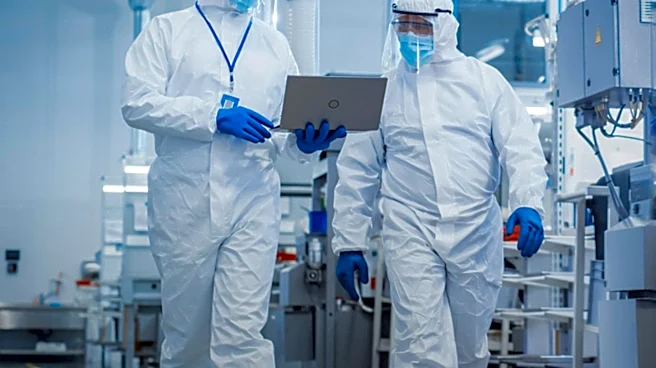
and address the timely delivery, distribution, and administration of medical countermeasures. A key focus is on regional and local manufacturing capacity, which is deemed essential for achieving self-sufficiency and ensuring vaccine administration equity, particularly in low- and middle-income regions. Currently, many such regions depend on external distributors, limiting their preparedness and responsiveness. Initiatives like SAVE (Serving Africa through Vaccine Equity), led by GeoVax, aim to improve this situation by collaborating with nations, NGOs, and other stakeholders to foster vaccine self-sufficiency. The discussion also underscores the risks of relying on single suppliers and the importance of qualifying multiple suppliers to ensure a resilient supply chain capable of timely response during outbreaks.
Why It's Important?
The push for diversified supply chains and regional manufacturing directly impacts global health security and equity. Relying on single suppliers creates vulnerabilities, as seen during past health crises where bottlenecks in production and distribution hindered rapid response. By fostering regional manufacturing, countries can reduce their dependence on external sources, ensuring a more equitable and timely distribution of vaccines and medical supplies, especially in underserved areas. This approach also strengthens economic resilience in these regions by creating local jobs and infrastructure. For the U.S., supporting such global initiatives can mitigate the risk of future pandemics spreading internationally and eventually affecting its own population and economy. A globally prepared world is a safer world, reducing the likelihood of widespread disruptions to trade, travel, and public health that have significant economic and social costs.
What's Next?
The ongoing efforts will likely involve increased collaboration between governments, NGOs, and pharmaceutical companies to establish and strengthen regional manufacturing hubs. Funding entities are expected to prioritize investments in diverse supply chains and local production capabilities. Discussions around international agreements, such as the WHO Pandemic Agreement, will continue to shape global strategies for prevention, preparedness, and response. Health systems and infection preventionists are urged to enhance their internal preparedness, including improving storage capacity, staff training, and distribution agreements, to ensure rapid deployment of vaccines when needed. The focus will also be on developing and validating vaccine technologies that reduce cold chain requirements, such as microarray patches, to further streamline distribution and accessibility.
Beyond the Headlines
The emphasis on regional manufacturing and multi-supplier networks reflects a broader shift towards de-globalization in critical supply chains, driven by lessons learned from recent global crises. This move has significant geopolitical implications, potentially altering power dynamics in global health by empowering developing nations with greater autonomy over their health security. Ethically, it addresses long-standing inequities in access to life-saving medical interventions, promoting a more just global health landscape. Legally, it may lead to new international frameworks and agreements that mandate or incentivize local production and technology transfer. Culturally, it fosters a sense of self-reliance and resilience within communities, moving away from a dependency model towards one of shared responsibility and localized capacity building, which could have lasting impacts on national development strategies.