


What's Happening?
CAF – Development Bank of Latin America and the Caribbean, and the Global Environment Facility (GEF) have launched a USD 10 million project named SargMarine to address the massive influxes of sargassum in the Greater Caribbean. The project, presented
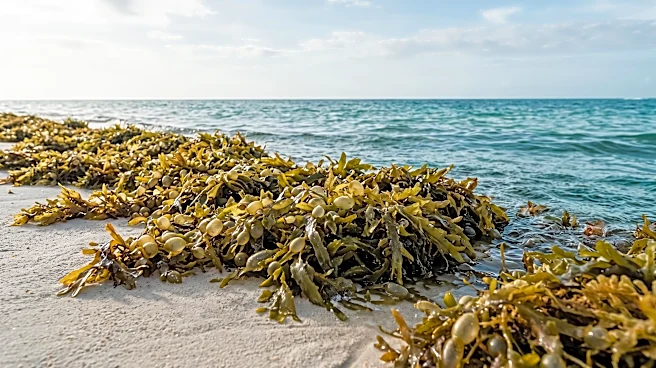
at COP31, aims to mitigate the impact of sargassum on marine and coastal ecosystems, tourism, fisheries, and local communities. The initiative will support Colombia, Panama, the Dominican Republic, Jamaica, Trinidad and Tobago, Grenada, and Saint Lucia. CAF will serve as the implementing agency, while the Organization of American States (OAS) will act as the executing agency. The Inter-American Institute for Global Change Research (IAI) will be a technical partner. The project also includes USD 67.3 million in co-financing. Key objectives include facilitating information sharing, strengthening countries' capacity to anticipate and manage sargassum influxes, and developing productive uses for sargassum to create economic opportunities. According to Lina Mondragón, CAF’s Climate Action and Positive Biodiversity Manager, sargassum is a transboundary phenomenon requiring strengthened regional mechanisms and joint action.
Why It's Important?
This project is crucial for the U.S. and the wider Caribbean region due to the severe ecological and economic damage caused by sargassum. Massive sargassum blooms disrupt marine ecosystems, harm fisheries, and significantly impact the tourism industry, a vital economic driver for many Caribbean nations. The U.S. also experiences sargassum wash-ups on its Gulf Coast and Florida beaches, affecting coastal communities and economies. By strengthening early warning systems and coordinating regional responses, the project can help mitigate these impacts, protecting coastal infrastructure and livelihoods. The development of productive uses for sargassum could also create new economic opportunities, turning a problem into a resource. The involvement of the OAS as an executing agency underscores the regional importance and collaborative nature of this environmental challenge, highlighting a unified approach to a shared problem that transcends national borders and has direct implications for U.S. environmental and economic interests in the region.
What's Next?
With final approval already secured, the SargMarine initiative is set to commence operations. The immediate next steps will involve the implementation of early warning systems, capacity-building programs for affected countries, and the initiation of research and development into productive uses for sargassum. Countries like Jamaica have prioritized strengthening monitoring and forecasting to better predict sargassum arrivals and locations, which will inform protection efforts and planning for its utilization. The project will also focus on fostering greater regional cooperation, as emphasized by Colombia's Minister of Environment and Sustainable Development, Fabio Arjona Hincapié, who stressed that 'local solutions definitely will not work on their own.' The success of the project will depend on effective coordination among the participating nations and agencies, as well as the successful translation of scientific information into actionable public policy and investment decisions. Continued monitoring of sargassum volumes, which reached a record 37.5 million tonnes in the Atlantic in May 2025, will be critical to assessing the project's impact.
Beyond the Headlines
Beyond the immediate environmental and economic benefits, this project highlights a growing trend of regional collaboration in addressing complex environmental challenges exacerbated by climate change. Sargassum influxes are increasingly linked to changing ocean currents and nutrient runoff, making this initiative a critical adaptation strategy. The project's focus on developing productive uses for sargassum, such as in agriculture or bioenergy, represents an innovative approach to waste management and resource recovery, potentially fostering a circular economy model in the Caribbean. This could lead to long-term sustainable development pathways for vulnerable island nations. Furthermore, the collaboration between development banks, environmental funds, and regional organizations like the OAS sets a precedent for integrated, multi-stakeholder approaches to transboundary environmental issues. It underscores the understanding that ecological problems often require solutions that bridge scientific research, policy-making, and economic development, fostering resilience in the face of global environmental shifts.