







What's Happening?
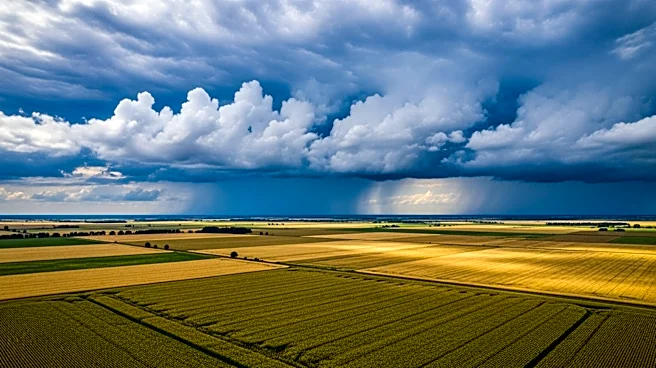
A study conducted by an international team of scientists has found that agricultural practices in the U.S. Corn Belt significantly contribute to the formation of large thunderstorm systems. The research, led by the U.S. National Science Foundation National Center
for Atmospheric Research, examined mesoscale convective systems (MCSs), which are clusters of thunderstorms that can span over 60 miles. The study concluded that moisture from crops, irrigation, and shallow groundwater increases atmospheric water vapor, enhancing storm updrafts and leading to more frequent and longer-lasting storms. These systems account for a substantial portion of the region's precipitation but also pose risks of flooding and severe weather.
Why It's Important?
The findings highlight the complex interactions between agricultural practices and weather patterns, emphasizing the need for integrated land and water management strategies. The Corn Belt is a critical agricultural region, and understanding how farming activities influence weather can help improve weather forecasting and agricultural planning. The study's insights could lead to better prediction models, aiding farmers in making informed decisions about planting and irrigation. Additionally, the research underscores the importance of considering environmental impacts in agricultural policy and land use planning to mitigate adverse weather effects.
What's Next?
The study suggests that future research should focus on refining atmospheric models to incorporate agricultural influences more accurately. Policymakers and agricultural stakeholders may need to collaborate on developing sustainable farming practices that minimize negative impacts on weather systems. This could involve exploring alternative irrigation methods or crop varieties that require less water. The findings also call for increased investment in weather monitoring and forecasting technologies to better predict and manage the effects of these enhanced storm systems.