





What's Happening?
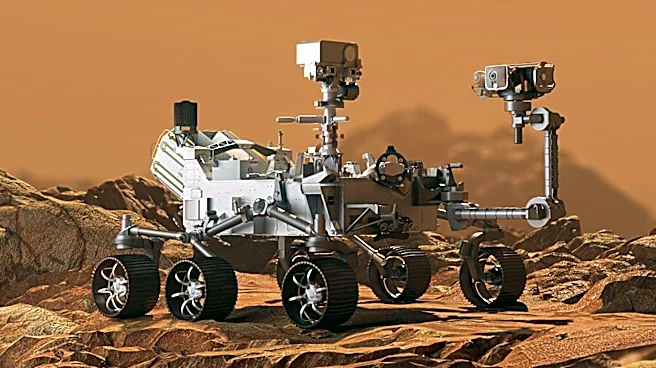
The Curiosity rover on Mars has captured several detailed mosaics of the Martian landscape, focusing on buttes named 'Mishe Mokwa' and 'Cordillera,' and looking back at 'La Linea.' Additionally, the rover documented the 'Chocolatal' scuff and a larger
mosaic of the 'Sullivan Field' sand field. These imaging efforts were conducted by the ChemCam long-distance imager and camera teams. The 'Sullivan Field' is notable for containing sand ripples, mega ripples, and transverse aeolian ridges, and was named in honor of Robert Sullivan, a recognized expert on Martian sands and a member of the Curiosity science team. The rover is currently traversing a subtly banded area within 'Valle Grande,' characterized by sparse, nodular outcrops and significant sand deposits. Recent activities included investigating brushed nodular bedrock at 'Cerro Armazones' and 'Monte Melimoyu,' and acquiring LIBS data on dark-toned nodules at 'Tuta Huallpas' and float rock 'Acllahuasi.'
Why It's Important?
These detailed mosaics and scientific investigations are crucial for understanding the geological history and atmospheric processes of Mars. By capturing high-resolution images of buttes, sand fields, and rock formations, scientists can gain insights into the planet's past environmental conditions, including the role of wind and water in shaping its surface. The study of sand ripples and aeolian ridges in 'Sullivan Field' provides valuable data on current Martian wind patterns and sediment transport, which is vital for future missions and potential human exploration. The identification of banded areas and different rock textures helps in mapping the stratigraphy of Mars, revealing layers of geological time and potential habitable environments. This ongoing data collection contributes significantly to the broader scientific goal of determining if Mars ever supported life and how its climate has evolved.
What's Next?
The Curiosity rover will continue its ascent through 'Valle Grande,' focusing on analyzing the subtle banded areas and their variations. Future plans include further investigation of rougher textures with MAHLI and APXS, and smoother areas with LIBS, to understand the composition and formation of these geological features. The environmental team will maintain its schedule of monitoring activities, such as dust-devil movies, suprahorizon movies, and tau images, to track atmospheric conditions and dust levels. The data collected from these observations will inform subsequent driving decisions and scientific targets, allowing the mission team to select optimal paths and prioritize areas of high scientific interest. The long-term goal remains to gather comprehensive data that will help piece together the geological and climatic history of Mars.
Beyond the Headlines
The continuous operation and data collection by the Curiosity rover underscore the enduring human quest for knowledge beyond Earth. Each mosaic and scientific measurement contributes to a growing archive of Martian data, pushing the boundaries of planetary science and inspiring future generations of scientists and engineers. The naming of 'Sullivan Field' after a cherished team member highlights the collaborative and human element of space exploration, recognizing the dedication of individuals to these monumental endeavors. The ability to reconstruct Martian environments from geological clues also offers a comparative planetology perspective, helping scientists better understand Earth's own geological processes and climate evolution. This mission serves as a testament to international scientific cooperation and technological innovation in unraveling the mysteries of our solar system.