
What's Happening?
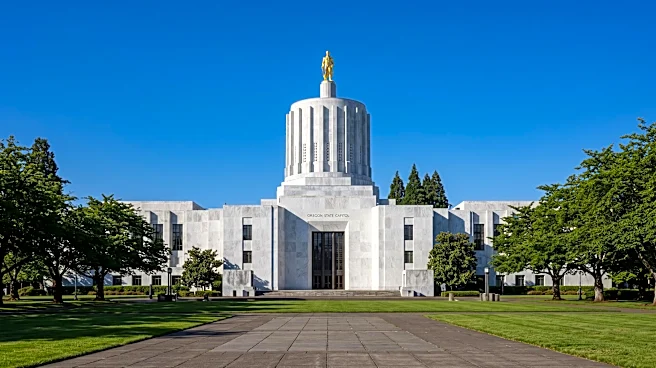
In Oregon, residents Watt and Jennifer Childress discovered that public potlucks are illegal, a fact not uniformly enforced across the state. The Oregon Health Authority (OHA) interprets existing laws,
which do not explicitly mention 'potlucks,' to classify public gatherings where home-cooked food is served as 'single-event temporary restaurants.' This classification prohibits the serving of food prepared in private homes to the public due to concerns about potential foodborne illness. Violations can lead to a Class C misdemeanor, carrying a fine of up to $1,250 and/or 30 days in jail. The Childresses learned of this restriction after their community events, including an auction for homemade pies, were deemed illegal by county health departments. While potlucks for specific, closed groups are permitted, those open to the general public are not. This interpretation has led to warnings and potential legal action against community organizers. The OHA cites incidents like a mass botulism outbreak in Ohio in 2015 from a church potluck as justification for these regulations.
Why It's Important?
This situation highlights a significant conflict between community traditions and public health regulations in Oregon. The prohibition on public potlucks impacts social cohesion and fundraising efforts for various organizations, including churches, arts groups, and fraternal organizations like the Grange. The Childresses argue that potlucks are crucial for community building, especially in a divisive climate, and even former U.S. Surgeon General Vivek Murthy has promoted them as a way to combat loneliness. The current law, as interpreted by the OHA, places Oregon among the strictest states regarding potluck regulations, contrasting sharply with states like Minnesota, which explicitly exempts potlucks from food safety laws, and Massachusetts, which allows them with proper disclosure. This disparity affects how communities can gather and share food, potentially stifling grassroots initiatives and informal social support networks. The legal ambiguity and inconsistent enforcement across counties also create confusion and a sense of unfairness among residents.
What's Next?
State Representative Cyrus Javadi, a Republican-turned-Democrat representing the North Oregon Coast, has committed to sponsoring a bill to amend the law, aiming to align Oregon with more permissive states like Minnesota. He hopes to introduce the legislation early next year, provided he is reelected. If not, he plans to find co-sponsors to continue the effort. The proposed bill is expected to be a 'straight-up policy bill' with no significant revenue or fiscal impact, which Javadi believes will facilitate its passage. Governor Tina Kotek's office has acknowledged the issue and stated that staff will work with the Oregon Health Authority to review relevant statutes and administrative rules to address local concerns. Additionally, Clatsop County Commissioner Lianne Thompson has voiced support for changing the law, emphasizing the importance of maintaining community traditions. The Oregon State Grange, unaware of the ban until recently, is also advocating for reform, having promoted community potlucks as part of national celebrations.
Beyond the Headlines
The debate over public potlucks in Oregon touches upon deeper issues concerning the balance between public health mandates and individual freedoms, as well as the role of government in regulating informal community activities. While the OHA's concerns about foodborne illness are legitimate, the broad interpretation of existing laws has inadvertently criminalized a long-standing cultural practice. This situation raises questions about the practicality and necessity of such stringent regulations for events that are often central to community identity and mutual support. The efforts by the Childresses and Representative Javadi to change the law reflect a broader desire to protect and foster community engagement, even in the face of bureaucratic hurdles. The outcome of this legislative push could set a precedent for how other states approach similar issues, potentially influencing the future of community gatherings and the interpretation of food safety laws across the nation.