







What's Happening?
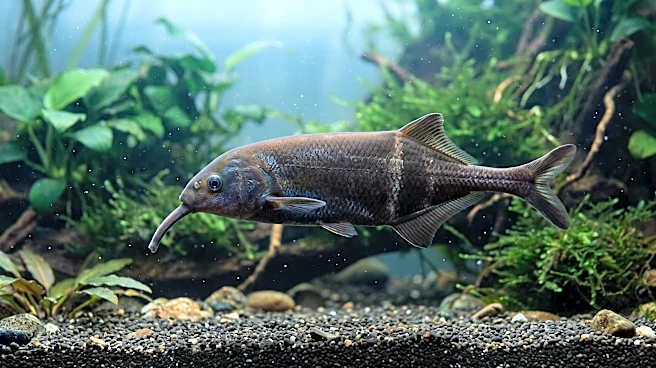
Researchers at Columbia University's Zuckerman Institute have meticulously mapped the brain cells of the African weakly electric fish, also known as the elephantnose fish, to understand how its electrosensory lobe continually learns to filter out self-generated
electrical interference. This fish emits electric signals to navigate and communicate, which can interfere with its ability to sense external electric fields. The study, published in Nature, revealed that the electrosensory lobe pairs cells with fast plasticity with those exhibiting slow plasticity. This pairing allows the brain circuit to quickly adapt to random noise while maintaining stability against consistent interference. Nathaniel Sawtell, PhD, co-senior author and a professor of neuroscience at Columbia's Vagelos College of Physicians and Surgeons, highlighted that biological systems offer valuable lessons for artificial systems, especially concerning continual learning where AI models often 'catastrophically forget' previously learned information when acquiring new data.
Why It's Important?
This research holds significant implications for the field of artificial intelligence, particularly in addressing the challenge of continual learning. Current AI models frequently suffer from 'catastrophic forgetting,' where learning new information erases previously acquired knowledge. By understanding how the electric fish's brain efficiently manages and filters noise while continuously learning, scientists can gain insights into developing more robust and adaptable AI systems. This could lead to advancements in machine learning algorithms that are capable of lifelong learning without compromising past knowledge. The findings could also influence the design of future AI architectures, making them more resilient to new data inputs and more efficient in processing complex, dynamic environments, ultimately benefiting various AI applications from robotics to data analysis.
What's Next?
The insights gained from mapping the electric fish's brain are expected to inform the development of new algorithms and architectures for artificial intelligence. Researchers will likely focus on translating the principles of dual-plasticity (fast and slow learning cells) observed in the fish's brain into computational models. This could involve creating AI systems that incorporate similar mechanisms to handle both transient and persistent data patterns, thereby improving their ability to learn continuously and adapt to changing environments without forgetting prior knowledge. Further studies may explore how these biological learning strategies can be integrated into existing AI frameworks, potentially leading to more sophisticated and human-like AI capabilities. Collaboration between neuroscientists and AI engineers will be crucial in bridging the gap between biological discoveries and practical AI applications.
Beyond the Headlines
The study delves into the fundamental mechanisms of learning and adaptation in biological systems, offering a deeper understanding of how brains process sensory information in complex environments. Beyond its direct application to AI, this research contributes to the broader field of neuroscience by elucidating the intricate wiring and functional dynamics of neural circuits. The concept of combining fast and slow plasticity for robust learning could be a universal principle applicable to various biological learning processes. Ethically, as AI systems become more sophisticated and capable of continuous learning, understanding these biological blueprints can help ensure that artificial intelligence develops in a way that is both powerful and aligned with human cognitive processes, potentially leading to more intuitive and less error-prone AI interactions.