




What's Happening?
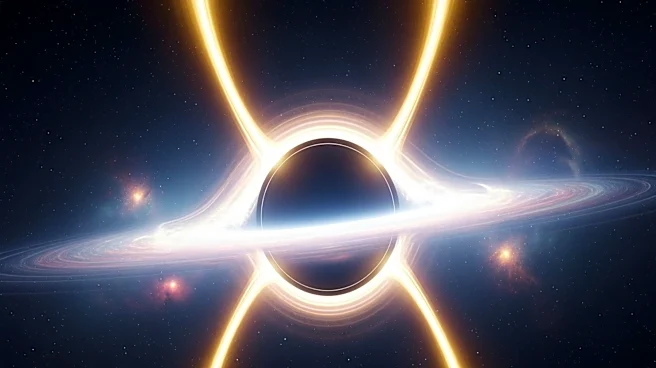
For the first time, scientists have successfully measured the instantaneous power of jets emitted from a black hole, revealing a force equivalent to 10,000 suns. This discovery was made by an international research team studying the black hole-star system
Cygnus X-1, located 7,200 light-years away. The system, which includes a black hole and a blue supergiant star, was the first black hole ever identified over fifty years ago. The research, led by Steve Prabu from the University of Oxford, utilized 18 years of high-resolution radio imaging from a global telescope network. The team observed that the jets, moving at half the speed of light, are influenced by the stellar wind from the supergiant star, which bends them in opposite directions. This study marks a significant advancement in understanding black hole dynamics, as previous measurements of jet power were averaged over thousands of years.
Why It's Important?
This breakthrough in measuring black hole jet power has significant implications for astrophysics. By understanding the energy dynamics of black holes, scientists can gain insights into how these cosmic phenomena influence the formation and evolution of galaxies. The ability to measure jet power in real-time allows researchers to study the interactions between black holes and their surrounding environments more accurately. This could lead to a better understanding of the role black holes play in shaping cosmic structures through large-scale shocks and turbulence. Additionally, the findings could inform future research on other black hole systems, potentially leading to new discoveries about the universe's most enigmatic objects.
What's Next?
Following this discovery, researchers plan to apply the same measurement techniques to other black hole systems. By expanding their study to include more systems, scientists hope to gather comprehensive data on black hole jet dynamics. This could lead to a broader understanding of the mechanisms driving jet emissions and their impact on the cosmos. The research team, led by Steve Prabu, aims to explore the potential for measuring jet power in various black hole environments, which could further illuminate the complex interactions between black holes and their stellar companions.