








What's Happening?
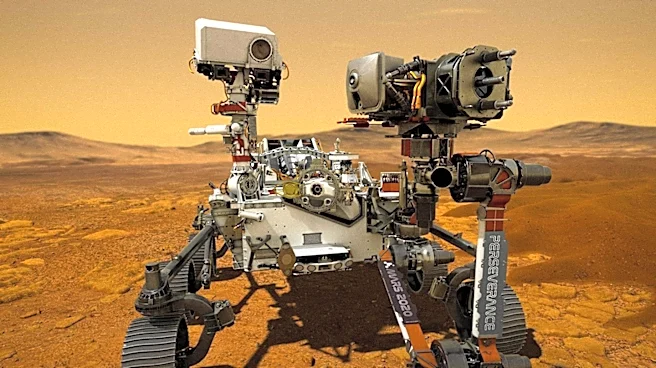
NASA's Perseverance rover has achieved a significant milestone by completing a marathon distance on Mars, covering 26.2 miles (42.195 kilometers) over five years and four months. This achievement was reached on the 1,890th Martian day, or sol, of its
mission. The rover's pace surpassed that of NASA's previous record holder, the Opportunity rover, which took over 11 years to cover the same distance. The Mars Reconnaissance Orbiter (MRO) captured a striking image of Perseverance from orbit, showing the rover as a small green speck against the Martian landscape. The image also revealed the tracks left by the rover as it explored the surface near Jezero Crater, in a region nicknamed 'Arbot' by the mission's science team. The mission is managed by NASA's Jet Propulsion Laboratory in Southern California, with contributions from Lockheed Martin Space and the University of Arizona.
Why It's Important?
The completion of a marathon distance by the Perseverance rover marks a significant achievement in space exploration, demonstrating the rover's durability and the success of NASA's engineering. This milestone not only highlights the technological advancements in rover design but also provides valuable data for future missions. The rover's journey across Mars contributes to the understanding of the planet's geology and climate, aiding in the search for signs of past life. The success of Perseverance supports NASA's long-term goals of human exploration of Mars, as it tests technologies and gathers information crucial for future manned missions. The achievement also underscores the collaborative efforts of various institutions, showcasing the importance of partnerships in advancing space exploration.
What's Next?
Following the completion of the marathon, Perseverance will continue its mission to explore the Martian surface, focusing on collecting rock and soil samples for potential return to Earth. The data gathered will be crucial for planning future missions, including those involving human exploration. NASA's ongoing Mars Exploration Program aims to further investigate the planet's habitability and prepare for eventual human settlement. The success of Perseverance may lead to the development of more advanced rovers and exploration technologies, enhancing the capabilities of future missions. Additionally, the rover's findings will inform the design of habitats and life support systems for astronauts, as NASA continues to work towards its goal of sending humans to Mars.