
What's Happening?
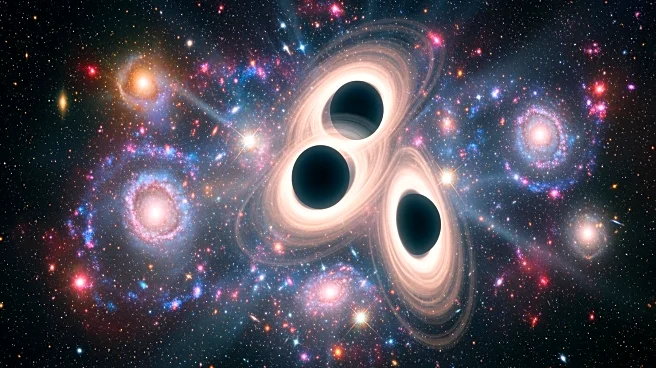
Astronomers have identified a rare cosmic event involving the merger of three supermassive black holes, each located at the center of separate galaxies. This phenomenon, observed by Emma Schwartzman and
her team at the US Naval Research Laboratory, is significant due to its rarity and the insights it provides into the physics of complex mergers. The black holes are actively feeding and emitting low-frequency radio waves, which allowed researchers to detect them using the Very Long Baseline Array in Hawaii and the Very Large Array in New Mexico. The galaxies involved are in the early stages of interaction, with two separated by approximately 70,000 light years and the third by 300,000 light years. This discovery marks a unique opportunity to study the dynamics of such mergers, which are typically difficult to observe due to their short-lived nature and the rarity of black holes emitting detectable light.
Why It's Important?
The observation of three supermassive black holes merging is a significant milestone in astrophysics, offering a rare glimpse into the processes that govern galaxy formation and evolution. Such events are crucial for understanding how supermassive black holes grow to their enormous sizes, often through mergers with other black holes during galactic collisions. This discovery could enhance our understanding of the universe's structure and the role of black holes in shaping it. The ability to detect these black holes through radio emissions, a first in this context, opens new avenues for observing similar phenomena in the future. The findings could also inform theoretical models and simulations, providing a more comprehensive picture of cosmic evolution.
What's Next?
Future research will likely focus on monitoring the ongoing interaction of these galaxies and their black holes to gather more data on the merger process. This could involve using additional radio observatories and other telescopic technologies to capture more detailed observations. The data collected will be crucial for refining existing models of black hole mergers and understanding the gravitational waves they produce. As the galaxies continue to interact, astronomers will have the opportunity to study the final stages of the merger, potentially leading to new discoveries about the behavior of supermassive black holes and their impact on their host galaxies.
Beyond the Headlines
This discovery highlights the importance of radio astronomy in uncovering hidden aspects of the universe. The ability to detect black holes through radio waves, which can penetrate dust and other obstructions, underscores the potential for discovering more such systems. The event also raises questions about the frequency of such mergers and their implications for the cosmic landscape. Understanding these processes could have broader implications for the study of gravitational waves and the search for other exotic cosmic phenomena.