





What's Happening?
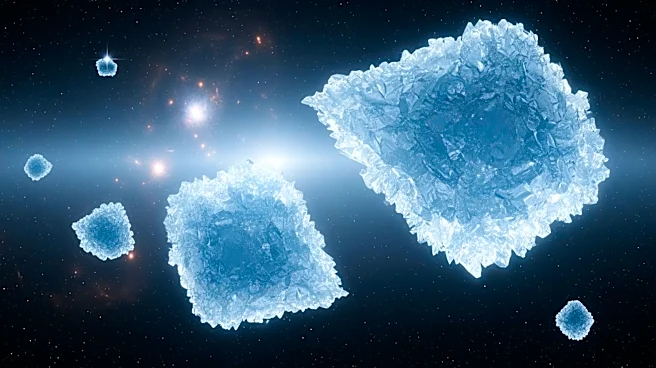
NASA's SPHEREx observatory has successfully mapped interstellar ice in the Milky Way, revealing chemical signatures of water ice and polycyclic aromatic hydrocarbons in the Cygnus X region. This observation, released on April 15, 2026, highlights one
of the most active star-forming areas in our galaxy. SPHEREx, launched in March 2025, is designed to map chemical signatures of various interstellar ices, including water, carbon dioxide, and carbon monoxide. These molecules are crucial for the chemistry that supports life development. The observatory's ability to see the sky in 102 colors allows it to gather unique data on galaxies, stars, and other cosmic features.
Why It's Important?
The mapping of interstellar ice by SPHEREx provides valuable insights into the chemical processes that occur in space and contribute to the formation of life-supporting molecules. Understanding these processes is essential for comprehending the origins of water in Earth's oceans and the ices found on comets and other celestial bodies. The data collected by SPHEREx can enhance our knowledge of star formation and the conditions necessary for life, potentially informing future space exploration missions. This research underscores the importance of space observatories in advancing our understanding of the universe and its potential for supporting life.