



What's Happening?
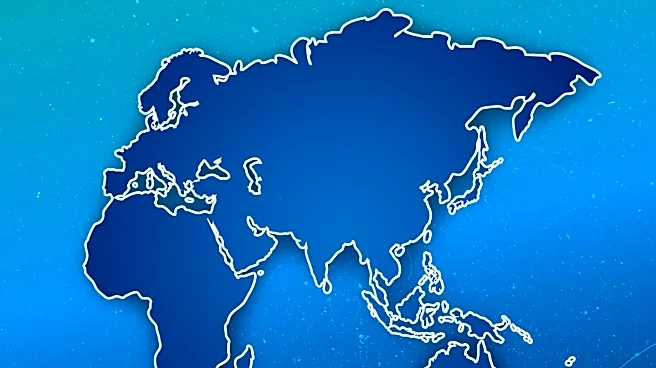
A new online quiz, 'Middle East Map Quiz,' has been launched to help users identify 17 countries and territories commonly associated with the Middle East. This interactive tool includes nations such as Egypt, Türkiye, Cyprus, Israel, and Palestine, alongside
countries in the eastern Mediterranean, the Gulf, Iraq, and Iran. The quiz acknowledges that the definition of the Middle East can vary, and its inclusions reflect common geographic and educational discussions. For instance, Egypt, primarily located in Africa, is included due to its frequent association with the region, and Türkiye, spanning Europe and Asia, is also featured. The quiz allows users to select Palestine using either the West Bank or Gaza markers, emphasizing that its map is designed for learning locations rather than taking a stance on disputed borders or political status. Users can engage in a study mode without a timer to explore names, capital cities, and location clues.
Why It's Important?
This map quiz is important for enhancing geographic literacy regarding a region of significant global interest. The Middle East is a complex area with diverse cultures, economies, and geopolitical dynamics. By providing a clear, interactive platform to learn the locations of these countries, the quiz can contribute to a better understanding of current events and historical contexts. The inclusion of countries like Egypt and Türkiye, which bridge continents, highlights the fluid nature of regional definitions and encourages a more nuanced perspective on global geography. Furthermore, the quiz's approach to disputed territories, such as Palestine, by allowing selection via specific markers without endorsing political claims, promotes an educational focus while acknowledging sensitive geopolitical realities. This tool can be particularly valuable for students, educators, and anyone seeking to improve their knowledge of this critical part of the world.
What's Next?
The 'Middle East Map Quiz' is designed for ongoing use as an educational resource. Its interactive format allows for continuous engagement, and future updates could potentially include additional features or expanded country lists based on user feedback or evolving geopolitical understandings. The quiz's emphasis on learning locations without taking political stances on disputed borders suggests a model that could be applied to other complex geographic regions globally. As global events continue to draw attention to the Middle East, tools like this quiz will remain relevant for fostering a more informed public. The platform's flexibility in study modes and untimed options ensures accessibility for a wide range of learners, from casual users to those seeking in-depth geographic knowledge.
Beyond the Headlines
The 'Middle East Map Quiz' subtly underscores a broader challenge in global education: the lack of a universally agreed-upon definition for many geographic regions. The varying inclusions of countries like Egypt, Türkiye, and Cyprus in different 'Middle East' maps reflect historical, cultural, and political considerations that often transcend purely geographic boundaries. This ambiguity can lead to misunderstandings in international discourse and policy. By explicitly addressing these variations and providing a comprehensive, yet flexible, set of inclusions, the quiz encourages critical thinking about how regions are defined and the implications of those definitions. It highlights the importance of understanding the diverse perspectives that shape our geographic understanding, moving beyond simplistic categorizations to appreciate the rich tapestry of global interconnectedness.