



What's Happening?
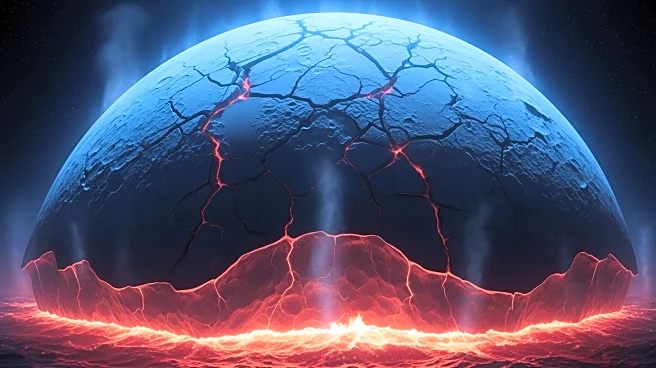
A recent study published in Nature Astronomy has explored the possibility of boiling oceans beneath the icy surfaces of moons such as Saturn's Enceladus and Uranus's Miranda. These moons, locked in thick ice shells, are believed to harbor vast oceans of liquid
water between their icy crusts and rocky interiors. The study, led by Max Rudolph from the University of California, Davis, investigates how tidal heating from the massive planets they orbit can cause these ice shells to melt and refreeze, potentially leading to boiling conditions in the underlying oceans. This process could explain the dramatic surface features observed on these moons, such as the 'tiger stripes' on Enceladus and the coronae on Miranda.
Why It's Important?
The findings of this study are significant as they provide insights into the geological processes that shape the surfaces of icy moons, which are considered prime candidates in the search for extraterrestrial life due to the presence of liquid water. Understanding these processes can help scientists predict the evolution of these moons over millions of years and assess their potential to support life. The study also highlights the role of moon size in these processes, with smaller moons like Mimas potentially having hidden oceans without visible surface activity, while larger moons like Titania may experience surface cracking due to pressure changes.
What's Next?
Future research may focus on further exploring these moons using advanced space missions to gather more data on their internal and surface dynamics. Such missions could provide more detailed observations of the surface features and help validate the study's findings. Additionally, understanding the conditions that lead to ocean boiling could inform the design of instruments and experiments aimed at detecting signs of life or habitability on these distant worlds.
Beyond the Headlines
The study raises intriguing questions about the potential for life in extreme environments and the adaptability of life forms to such conditions. It also underscores the importance of interdisciplinary research, combining planetary science, geology, and astrobiology, to unravel the mysteries of our solar system. The findings could influence future space exploration priorities and funding, as well as inspire new technologies for probing icy worlds.