






What's Happening?
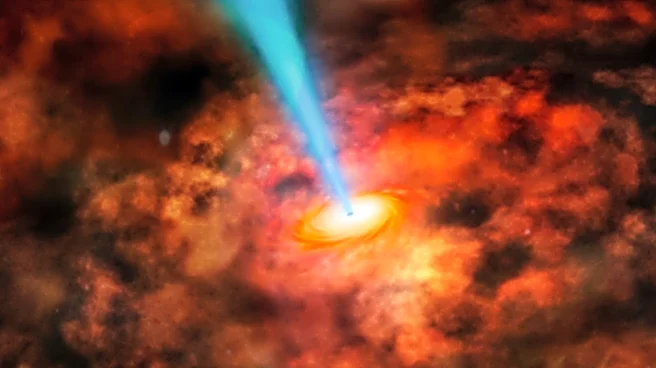
Astronomers have discovered an unusual star system, GPM J071507−114153, located 5,000 light-years from Earth, that emits mysterious radio signals every eight minutes. This system consists of a white dwarf, a dense core left after a star dies, and a G-type
star similar to our Sun, orbiting each other. This marks the first time radio pulses have been detected from a white dwarf orbiting a Sun-like star; typically, such pulses are observed in systems with smaller, cooler red dwarf stars. Researchers at the International Centre for Radio Astronomy Research (ICRAR) in Perth, Western Australia, made this discovery. Study lead author Dr. Sam McSweeney noted that the clarity of the pulses allowed them to observe the white dwarf's orbital motion, confirming the pulsations originate from near or on the white dwarf itself. The team processed over 100 hours of radio data at the Pawsey Supercomputing Research Centre to validate their findings.
Why It's Important?
This discovery breaks new ground in astrophysics by challenging existing understandings of long-period transients (LPTs), a class of objects that produce radio signals switching on and off over minutes to hours. The unique pairing of a white dwarf with a Sun-like star, rather than a red dwarf, expands the known diversity of LPT systems and provides new data for astronomers to refine their models of stellar evolution and radio emission mechanisms. The ability to detect stellar flares on the Sun-like companion, similar to Earth's aurorae, and even a 'stellar prominence' (a large loop of plasma erupting from the star's surface) through the white dwarf's pulses, demonstrates the advanced capabilities of radio astronomy. This research, published in Nature Astronomy, highlights the potential for future discoveries with next-generation telescopes like the Square Kilometre Array Observatory (SKAO).
What's Next?
The discovery of GPM J071507−114153 will likely spur further research into long-period transients and the conditions under which white dwarfs can emit radio pulses, especially in binary systems with Sun-like companions. Astronomers will continue to analyze data from this system and search for similar ones to better understand the underlying physics. The insights gained from this rare system will contribute to the development of more comprehensive theories about stellar interactions and the evolution of binary star systems. As advanced telescopes like SKAO are fully built, researchers anticipate discovering many more such star systems and obtaining even more detailed views of their signals, potentially leading to a deeper understanding of the universe's radio-emitting phenomena.