


What's Happening?
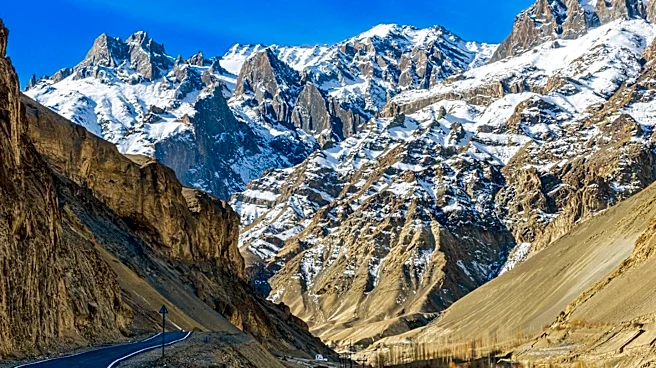
The Taliban-led government in Afghanistan has announced the completion and opening of a new road through the Wakhan Corridor in Badakhshan province, leading to the Chinese border. The road, constructed in two phases for 365 million Afghanis ($5.5 million),
is an unpaved track covered with gravel. The Afghan Ministry of Rural Rehabilitation and Development stated that the project aims to open new trade routes and reduce reliance on Pakistan. However, there is no official Chinese customs facility at the Wakhjir Pass, and China's Ministry of Foreign Affairs has not commented on the road's opening. Beijing views the Wakhan Corridor primarily as a sensitive security issue, focusing on protecting its western border, preventing armed groups from entering Xinjiang, and safeguarding its investments in natural resources. Major Chinese investments in Afghanistan, such as an oil exploration contract and the Mes Aynak copper mine project, have stalled.
Why It's Important?
This development highlights Afghanistan's efforts to diversify its trade outlets and reduce its dependence on neighboring countries like Pakistan and Iran, which have recently seen disruptions to trade routes. For the U.S., this situation underscores the complex geopolitical landscape in Central Asia and the challenges of regional stability. While the road could potentially link South, East, and Central Asia, fostering trade and economic integration, China's cautious approach, driven by security concerns, limits its immediate impact. The U.S. has a vested interest in regional stability and counter-terrorism efforts, and China's focus on preventing Uighur separatist groups from entering Xinjiang through this corridor aligns with broader security objectives, albeit with different motivations. The stalled Chinese investments also reflect the ongoing economic and political uncertainties in Afghanistan under Taliban rule, which could affect future international engagement and development in the region.
What's Next?
The immediate future of the Wakhan Corridor as a trade route hinges on China's willingness to open its border to commercial traffic. Beijing has indicated that it links the implementation of the project to effective security guarantees, particularly regarding the East Turkestan Islamic Movement. The Taliban government will likely continue to seek financial support from China for further development of the trade route and work to demonstrate its ability to maintain security in the region. Regional and international stakeholders will closely monitor the situation, as the corridor's potential to reshape trade and influence patterns across Asia is significant. The ongoing security tensions in Badakhshan, including protests against poppy field destruction and attacks by the National Resistance Front, could further complicate China's decision-making process regarding border opening and investment.
Beyond the Headlines
The Wakhan Corridor's historical significance as a buffer zone between competing empires in the 19th century now evolves into a modern geopolitical crossroads. The current situation reveals a tension between Afghanistan's economic ambitions and China's paramount security concerns, particularly regarding the Xinjiang region and Uighur populations. The U.S. and its allies have criticized China's human rights record in Xinjiang, adding another layer of complexity to any potential collaboration or trade facilitation through this corridor. The Taliban's push for this road also reflects a broader strategy to gain international legitimacy and economic self-sufficiency, challenging the isolation imposed by many international actors. The long-term implications could include a shift in regional power dynamics and trade routes, potentially impacting the effectiveness of international sanctions and aid efforts if Afghanistan finds alternative economic lifelines.